


Cita
Cuando una patente nueva menciona otra anterior como referencia. Más citas = más influencia.
Other Consumer Goods · 2025
Las 22 patentes que más han servido de referencia para los nuevos inventos del área.
Cuando una patente nueva menciona otra anterior como referencia. Más citas = más influencia.
El evaluador de la Oficina de Patentes de EE. UU. Cita lo que se parece demasiado a la solicitud.
demasiado parecidaLa empresa o el inventor que pide la patente. Cita lo que le sirvió de inspiración.
fuente de inspiraciónLos inventos que la Oficina más usó como comparación: los más parecidos a lo que se patenta hoy.
Destacados
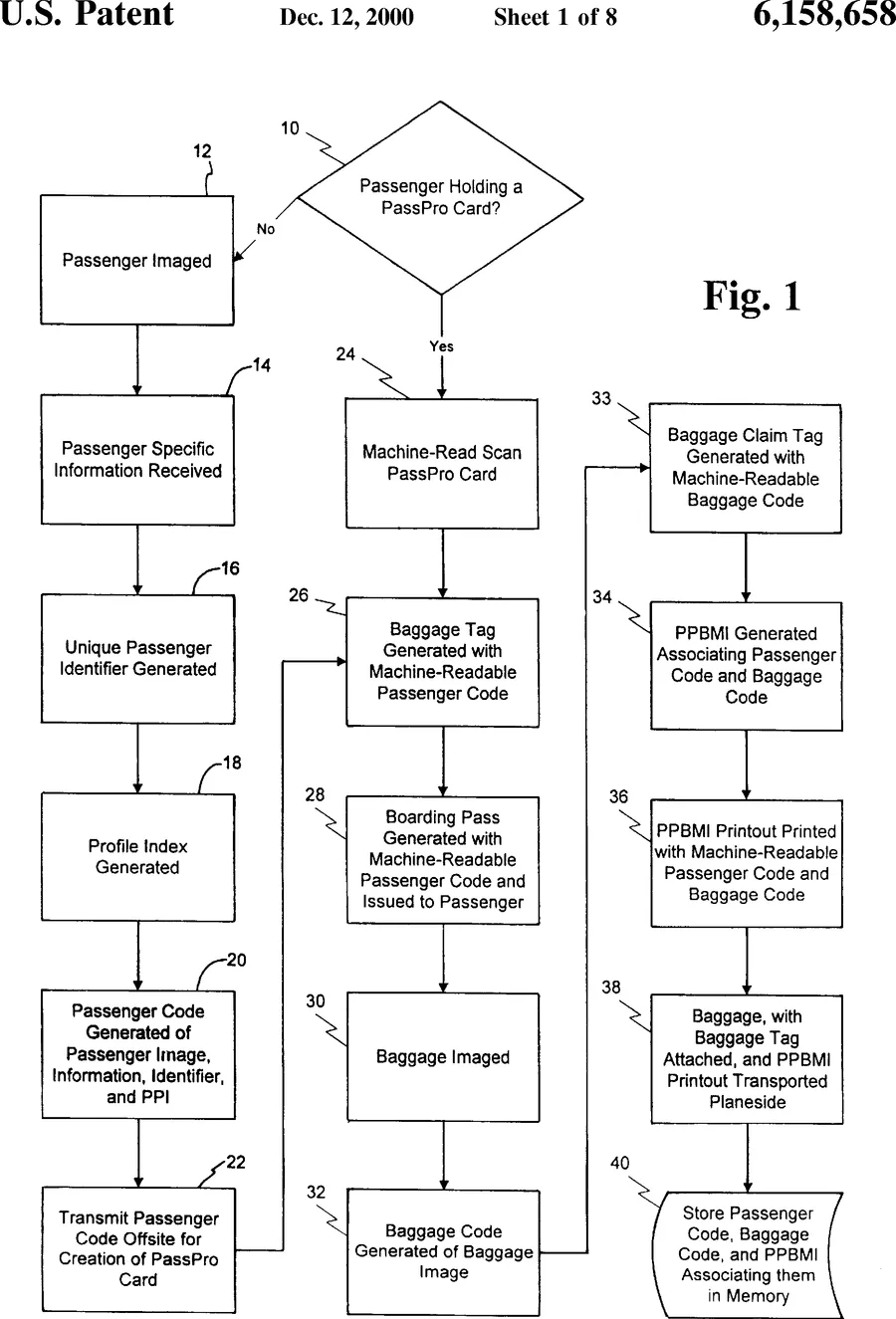
Laser Data Command Inc 2000
Inventor: John L. BarclayA system and method for enhancing passenger security in the travel industry by matching passengers with their baggage through storage of images of passengers and their baggage and other textual data in computer memory and in printed codes which may be on passenger baggage, a boarding pass, a positive passenger bag identifier, and a passenger identification card. The codes on boarding passes are scanned at the boarding gate before passengers may board to check whether the passenger image recovered from the code matches that of the passenger attempting to board. The boarding gate scan also generates a passenger manifest which, when compared to the list of passengers who checked baggage, identifies passengers who checked baggage but did not board. Positive passenger baggage match identifiers are generated associating passengers and the coded image of the baggage checked by the passenger. The positive passenger baggage matching identifiers corresponding to the unboarded passengers may be identified, thereby permitting recovery of an image of the unboarded passengers' baggage. The baggage may then be identified visually and removed or inspected prior to departure of the commercial carrier.
11citas
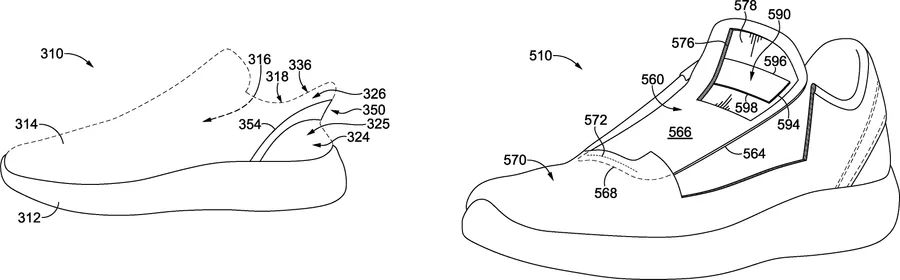
Nike Inc 2019
3 inventores: Austin J. Orand y 2 más11citas
Nine West Group Inc 2000
2 inventores: Clifford L. Pyle y 1 másClasificación completa
Cada número indica cuántas veces la patente sirvió de referencia para nuevas patentes concedidas en EE. UU. en 2025. Toca cualquiera para ver el dibujo, quién la inventó y de qué trata.
Laser Data Command Inc2000
14citas
Líder de la listaDe qué trata · original en inglés
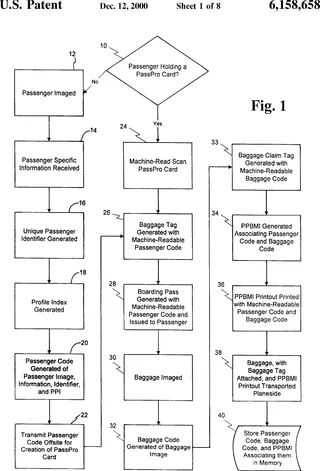
A system and method for enhancing passenger security in the travel industry by matching passengers with their baggage through storage of images of passengers and their baggage and other textual data in computer memory and in printed codes which may be on passenger baggage, a boarding pass, a positive passenger bag identifier, and a passenger identification card. The codes on boarding passes are scanned at the boarding gate before passengers may board to check whether the passenger image recovered from the code matches that of the passenger attempting to board. The boarding gate scan also generates a passenger manifest which, when compared to the list of passengers who checked baggage, identifies passengers who checked baggage but did not board. Positive passenger baggage match identifiers are generated associating passengers and the coded image of the baggage checked by the passenger. The positive passenger baggage matching identifiers corresponding to the unboarded passengers may be identified, thereby permitting recovery of an image of the unboarded passengers' baggage. The baggage may then be identified visually and removed or inspected prior to departure of the commercial carrier.
Nike Inc2019
11citas
79 % del 1.º (14)De qué trata · original en inglés
A footwear article includes a tongue and a tongue reinforcer, which helps the tongue maintain a shape and position when the tongue is subjected to forces or adjustments, such as from other footwear-article elements or from a wearer. For example, the tongue reinforcer may help the tongue maintain a shape and position when a wearer is inserting his or her foot into the footwear article or when medial and/or lateral quarters press inward on the tongue.
Nine West Group Inc2000
11citas
79 % del 1.º (14)De qué trata · original en inglés
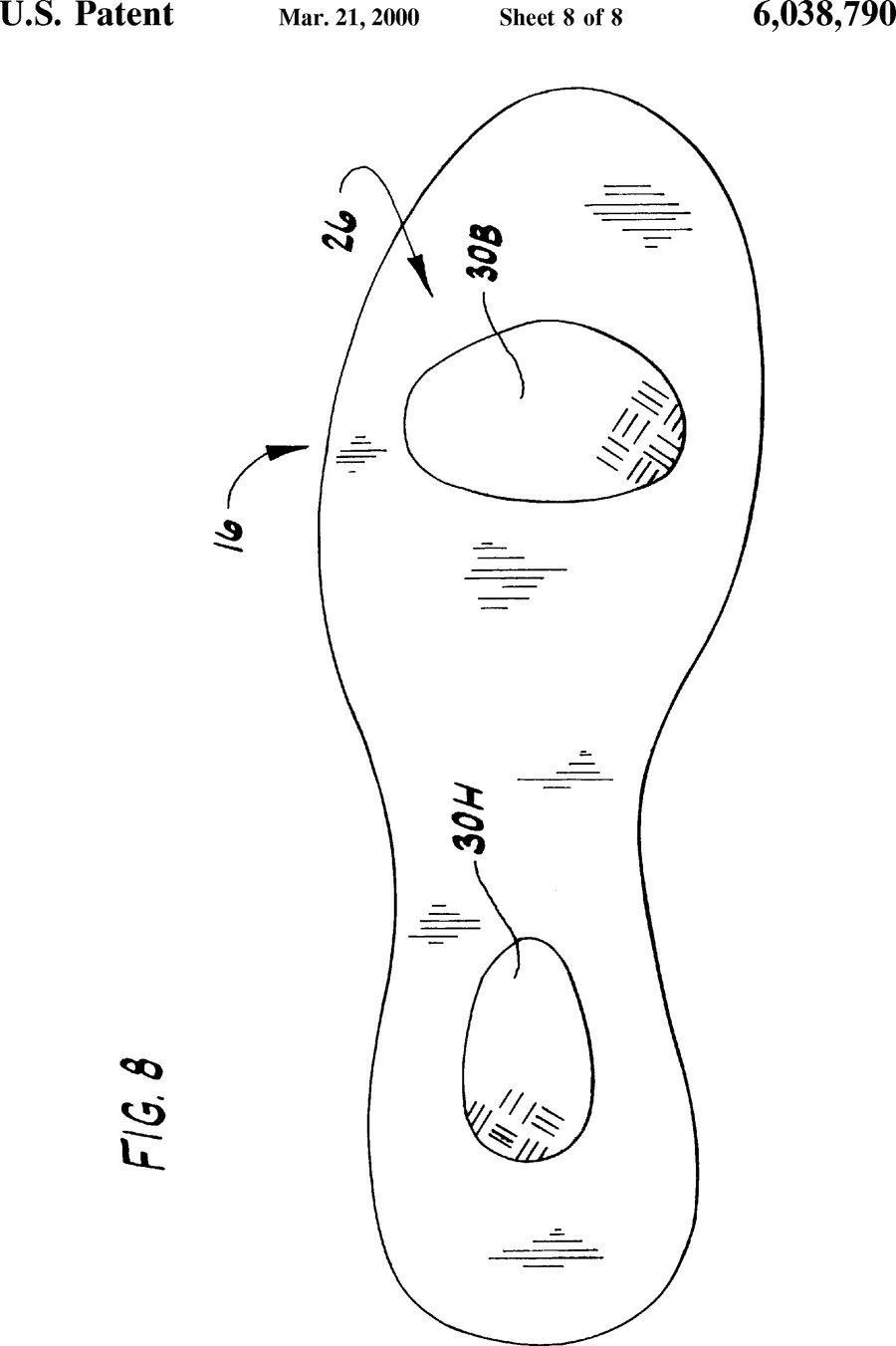
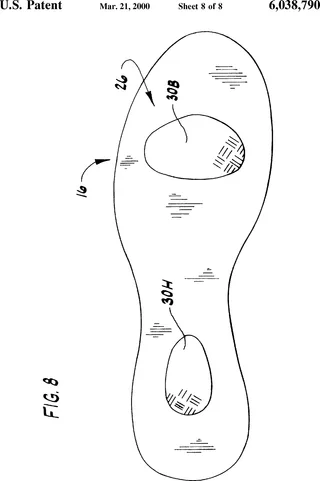
A shoe sole has cushioning in ball and heel regions of the sole. The sole includes an insole which has openings in the ball and heel regions which increase the flexibility of the insole. The insole openings are filled in by a soft insole pad so that the insole does not form a barrier to cushioning the ball and heel of the foot. The outsole also has openings in ball and heel regions which are closed by clear covers. The openings provide for good flexibility of the outsole. A soft cushion is held in the cover for further cushioning of the ball and heel of the foot.
Inventores independientes2024
10citas
71 % del 1.º (14)De qué trata · original en inglés
The invention presents a method and system for check-in processes for passengers on return travel. The method involves, after arriving at a destination, electronically acquiring an originating hardcopy bag tag identifier (OP-BTI) associated with or printed on a printed bag tag from an originating airline carrier that is on a luggage item of a passenger to create a digital BTI data record linked to the originating airline carrier. The process involves accessing a B-type message using a unique identifier representative of the BTI data record from a computer system associated with an originating airline carrier linked to information of a passenger name record (PNR). The process includes retrieving check-in information of a return leg of travel of the passenger with a designated return travel carrier using information associated with the PNR, and checking in the passenger with the designated return travel carrier using the retrieved check-in information, during a check-in window.
Inventores independientes1986
10citas
71 % del 1.º (14)De qué trata · original en inglés
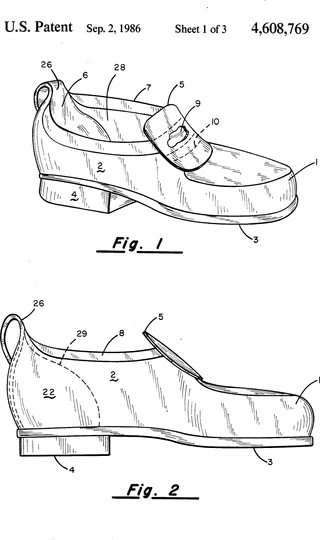
An improved construction of a shoe which permits the wearer to more readily step into the shoe without the use of his hands and which does not result in damage to the shoe. The shoe's counter incorporates a rigid shoe horn member generally conforming to the shape of the wearer's heel. The lateral edges of the foot receiving opening in the upper of the shoe is rolled and padded so that it does not become crushed as the wearer's foot is slipped into the shoe. The tongue member is reinforced with a stiffner which, too, precludes the tongue from wrinkling and/or rolling up as the foot is inserted into the shoe. Finally, an adjustable elasticized securing mechanism is adapted to bridge the metatarsal arch is included to allow the foot to spread the shoe during entry but which restores the shoe to a tight fit once the foot is inside.
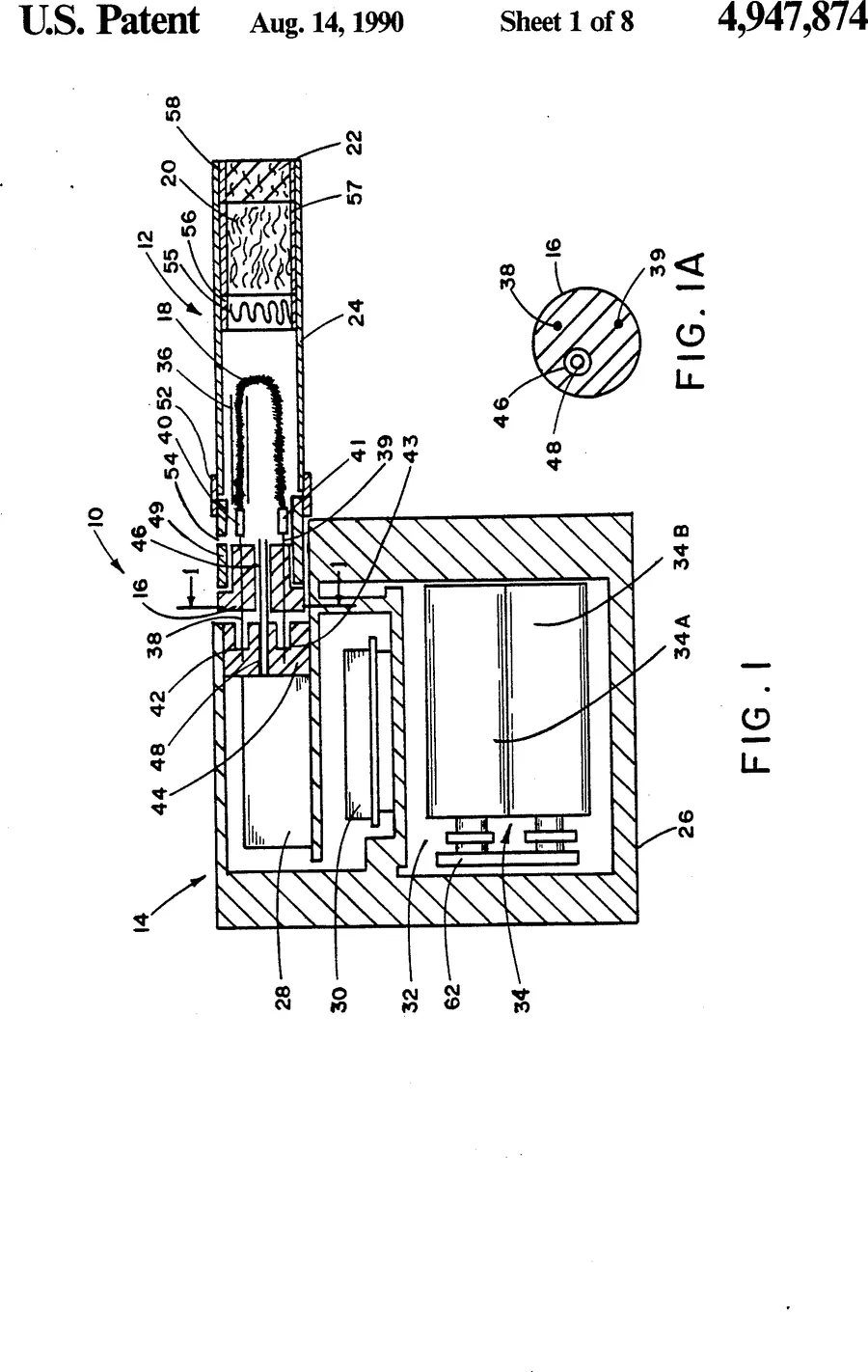
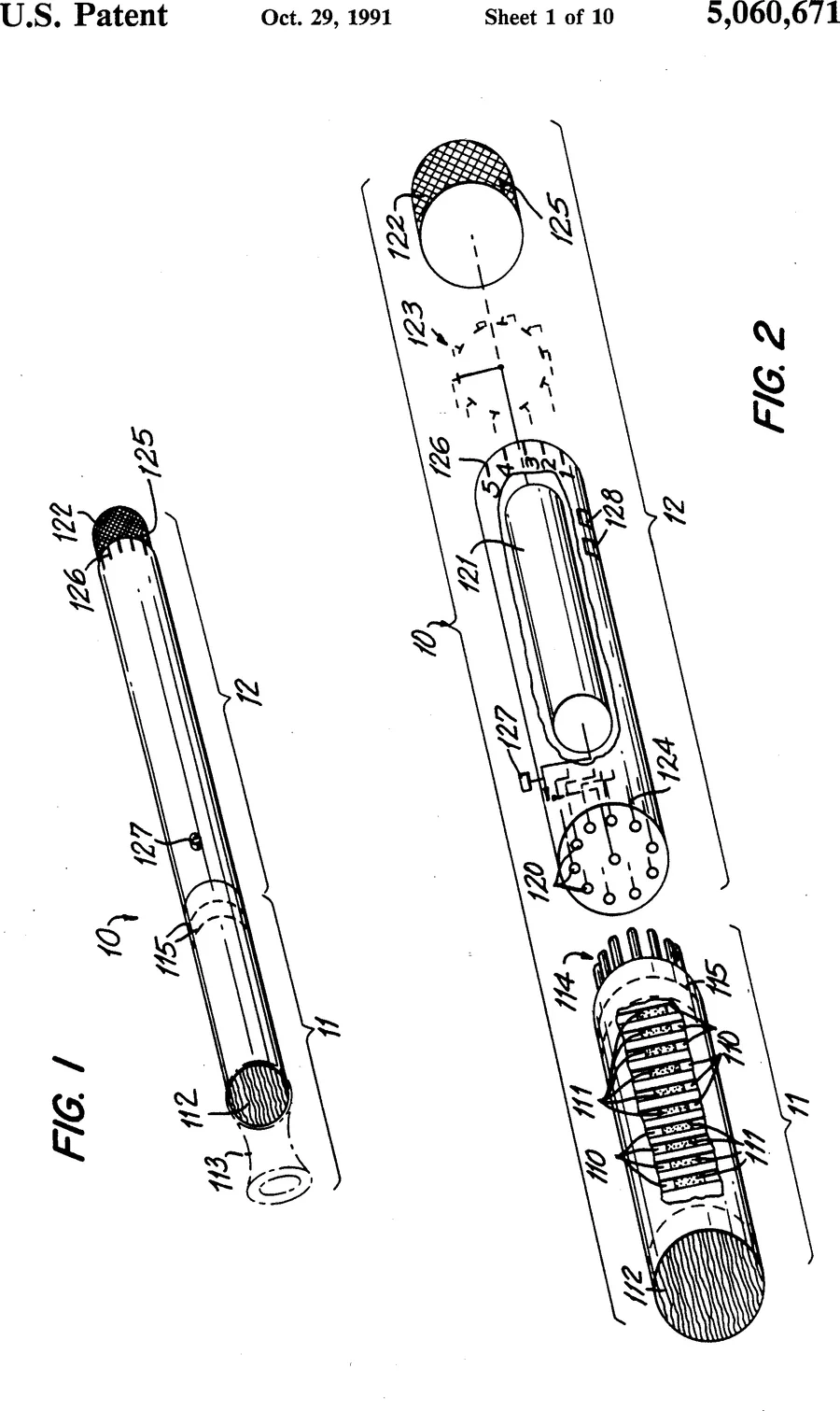
RJ Reynolds Tobacco Co1990
10citas
71 % del 1.º (14)De qué trata · original en inglés
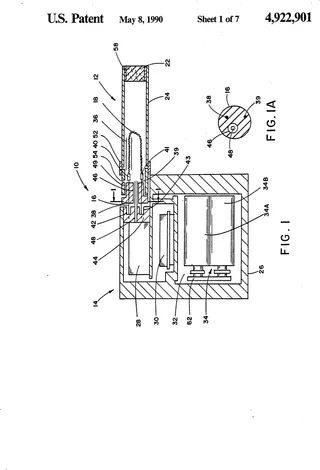
Drug delivery articles employ an electrical resistance heating element and an electrical power source to provide a dose of a drug in aerosol form. The articles advantageously comprise a disposable portion and a reusable controller. The disposable portion, normally includes a drug and an air permeable resistance heating element having a surface area greater than 1 m 2 /g, which usually carries an aerosol forming material. The reusable controller normally includes a puff-actuated current actuation means, a time-based current regulating means to control the temperature of the heating element, and a battery power supply.
Inventores independientes1916
9citas
64 % del 1.º (14)Nippon Rubber USA Corp1973
9citas
64 % del 1.º (14)De qué trata · original en inglés
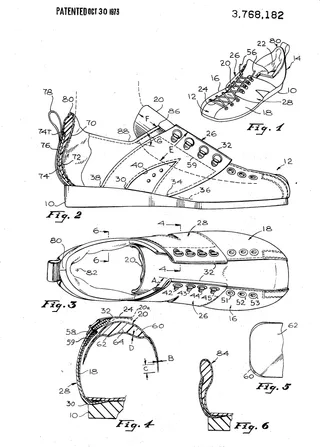
An athletic shoe designed for wear without stockings, which avoids discontinuities where the shoe is tight against the foot, which permits considerable expansion to accommodate a range of widths and arch heights, but which firmly encircles the foot for a tight fit that is desired in athletic shoe wearing. The shoe has soft side walls and a reinforcing overlay on either side, with the bottom of the overlay extending between a point immediately behind the ball of the foot to a point immediately behind the arch, and with the top of the overlay extending forwardly from the bottom and to a locgtion above the soft side walls, the top of the overlay carrying lacing rings so that the tops of the overlays are laced together over the tongue. The rear of the shoe has a padding and liner extending with a forward directional component over the top of the stiff counter. The tongue of the shoe is very wide and long and is greatly skived at its edges.
Inventores independientes1987
8citas
57 % del 1.º (14)De qué trata · original en inglés
The present invention relates to podiatric appliances for a person's foot, and more particularly, to a device for the heel of a person's foot, which, when worn, provides cushioning for the heel to minimize friction and discomfort to the heel and reduces stocking wear.
RJ Reynolds Tobacco Co1990
8citas
57 % del 1.º (14)De qué trata · original en inglés
Flavor delivery articles employ an electrical resistance heating element and an electrical power source to provide a flavored aerosol. The articles advantageously comprise a disposable portion and a reusable controller. The disposable portion normally includes a flavor substance and an air permeable resistance heating element having a surface area greater than 1 m 2 /g, which usually carries an aerosol forming substance. The reusable controller normally includes a puff-actuated current actuation means, a time-based current regulating means to control the temperature of the heating element, and a battery power supply.
Philip Morris Inc1995
8citas
57 % del 1.º (14)De qué trata · original en inglés
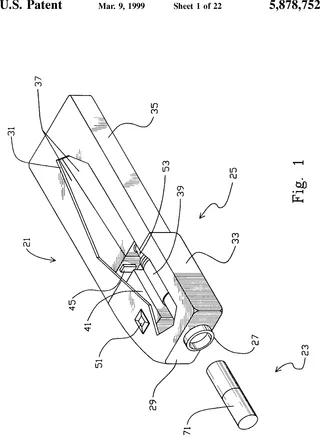
A smoking system is provided in which a replaceable cigarette containing tobacco flavor material is electrically heated by a set of electrical heater elements contained within a lighter to evolve tobacco flavors or other components in vapor or aerosol form for delivery to a smoker. The cigarette and lighter are adapted to provide air flow patterns through the smoking system such that air flows transversely into the cigarette. Such patterns improve aerosol and flavor delivery to the smoker and reduce the condensation of residual heater-region vapor/aerosol in the smoking system.
Philip Morris Inc1997
8citas
57 % del 1.º (14)De qué trata · original en inglés
An induction heating source is provided for use with an electrical smoking article. The induction heating source provides an alternating electromagnetic field which inductively heats a susceptor in thermal proximity with tobacco flavor medium to generate aerosols. A plurality of induction heaters are employed and/or the tobacco flavor medium is translated with respect to the induction heater or susceptor. The tobacco flavor medium can form an intimate structure with the susceptor and can take the form of a cylindrical cigarette or a web.
Philip Morris Inc1999
8citas
57 % del 1.º (14)De qué trata · original en inglés
Methods and apparatuses for cleaning an electrical lighter are provided. A sleeve, e.g., ceramic or metal, surrounds the heater fixture, and a resistive heating element is in thermal proximity with the sleeve. The resistive heating element is either a dedicated element or the cigarette heating elements. The sleeve serves as a aerosol barrier and condensate accumulator to protect other components. Periodically, e.g., substantially contemporaneously with a battery recharge, the heating element is activated to thermally liberate condensates deposited on the sleeve during smoking and also heats, and thereby cleans, other components. Also, a cleaning element is optionally inserted into the cigarette receptacle of the electrical lighter or placed at the exit thereof to absorb, attract and/or catalytically break down the thermally liberated condensates. The sleeve also directs a desired flow path for drawn air within an electrical lighter toward the cigarette.
LAT Enterprises Inc2017
8citas
57 % del 1.º (14)De qué trata · original en inglés
A portable battery pack comprising a battery enclosed by a wearable and replaceable pouch or skin is disclosed, wherein the pouch or skin can be provided in different colors and/or patterns. Further, the pouch or skin can be MOLLE-compatible. The battery comprises a battery element housed between a battery cover and a back plate, wherein the battery element, battery cover, and back plate have a slight curvature or contour. Further, the battery comprises flexible leads.
Los inventos que las propias empresas señalaron como base de su trabajo: las referencias del mercado.
Destacados
RJ Reynolds Tobacco Co 1990
3 inventores: Johnny L. Brooks, Donald L. Roberts y 1 másSmoking articles employ an electrical resistance heating element and an electrical power source to provide a tobacco-flavored smoke or aerosol and other sensations of smoking. The smoking articles advantageously comprise a disposable portion and a reusable controller. The disposable portion, which may be a cigarette, normally includes (i) an air permeable resistance heating element having a surface area greater than 1 m 2 /g, which usually carries an aerosol forming material, and (ii) a charge or roll of tobacco. The reusable controller normally includes a puff-actuated current actuation means, a time-based current regulating means to control the temperature of the heating element, and a battery power supply.
90citas
Philip Morris Inc 1991
7 inventores: Mary E. Counts y 6 más86citas
Japan Tobacco Inc 2000
Inventor: Manabu TakeuchiClasificación completa
Cada número indica cuántas veces la patente sirvió de referencia para nuevas patentes concedidas en EE. UU. en 2025. Toca cualquiera para ver el dibujo, quién la inventó y de qué trata.
RJ Reynolds Tobacco Co1990
96citas
Líder de la listaDe qué trata · original en inglés
Smoking articles employ an electrical resistance heating element and an electrical power source to provide a tobacco-flavored smoke or aerosol and other sensations of smoking. The smoking articles advantageously comprise a disposable portion and a reusable controller. The disposable portion, which may be a cigarette, normally includes (i) an air permeable resistance heating element having a surface area greater than 1 m 2 /g, which usually carries an aerosol forming material, and (ii) a charge or roll of tobacco. The reusable controller normally includes a puff-actuated current actuation means, a time-based current regulating means to control the temperature of the heating element, and a battery power supply.
Philip Morris Inc1991
90citas
94 % del 1.º (96)De qué trata · original en inglés
An article is provided in which a flavor generating medium is electrically heated to evolve inhalable flavors or other components in vapor or aerosol form. The article has a plurality of charges of the flavor generating medium which are heated sequentially to provide individual puffs.
Japan Tobacco Inc2000
86citas
90 % del 1.º (96)De qué trata · original en inglés
A flavor-generating device includes a chamber having an air inlet port and a flavor inhalation port, and defining a gas passageway between the air inlet port and the inhalation port. A liquid container for storing a liquid flavor source is provided, and is maintained at substantially an atmospheric pressure. At least one liquid passageway is provided in fluid communication with the liquid flavor source at its first end portion and with the gas passageway at its second end portion. The liquid passageway transports the liquid flavor source therethrough by capillary force. A heater heats and evaporates the liquid flavor source at the second end portion of the liquid passageway.
Philip Morris Inc1992
85citas
89 % del 1.º (96)De qué trata · original en inglés
Methods and apparatus for releasing flavor components from a flavor-generating medium using an electric heating element are provided. A non-combustion flavor-generating article uses electrical energy to power a heating element which heats tobacco or other flavorants. The flavor-generating medium is formed into a packed bed. Energy delivered to the heating element is regulated to maintain the flavor-generating medium at a relatively constant operating temperature to ensure a relatively constant release of flavor.
Best Partners Worldwide Ltd2010
85citas
89 % del 1.º (96)De qué trata · original en inglés
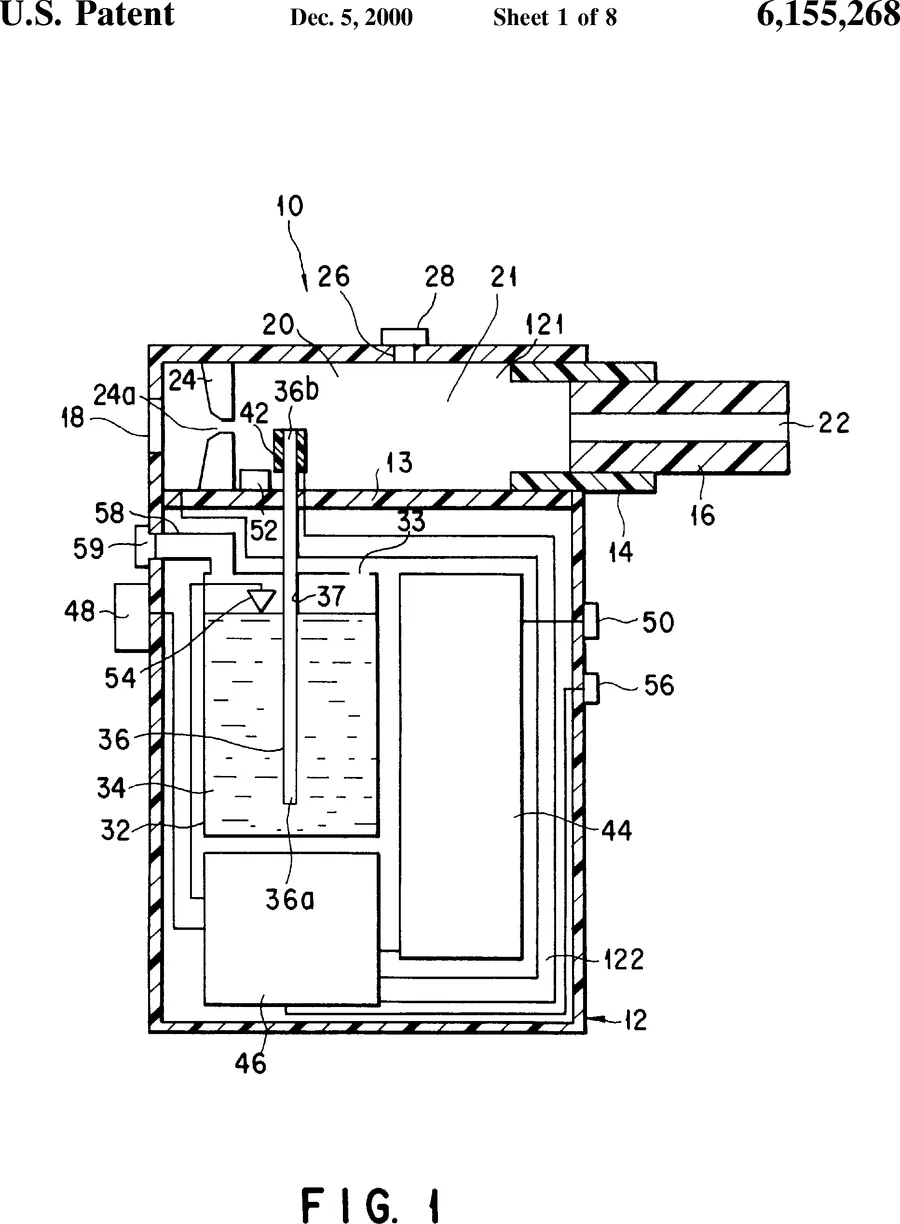
The invention relates to an electronic atomization cigarette which only contains nicotine without harmful tar. The electronic atomization cigarette includes a shell and a mouthpiece. The external wall of the shell has an air inlet. An electronic circuit board, a normal pressure cavity, a sensor, a vapor-liquid separator, an atomizer, a liquid-supplying bottle are sequentially provided within the shell, wherein the electronic circuit board comprises an electronic switching circuit and a high frequency generator. A stream passage of the sensor is provided on one side of the sensor, and a negative pressure cavity is provided in the sensor. The atomizer and the liquid-supplying bottle is in contact with each other. An atomization cavity is arranged in the atomizer. A retaining ring for locking the liquid-supplying bottle is provided between one side of the liquid-supplying bottle and the shell, and an aerosol passage is provided on the other side of the liquid-supplying bottle. The air inlet, normal pressure cavity, vapor-liquid separator, atomizer, aerosol passage, gas vent and mouthpiece are sequentially interconnected.
Philip Morris Inc1994
79citas
82 % del 1.º (96)De qué trata · original en inglés
A smoking article is provided in which a flavor-generating medium is heated electrically to release an aerosol for inhalation by a consumer. The smoking article includes a heater having resistive heating elements printed on a flexible substrate. The heater can be manufactured by circuit board mass production techniques, and can be formed to fit inside an article of the same shape and size as a conventional cigarette. Alternatively, the heater comprises an array of heating elements onto which charges of flavor-generating medium are deposited. The heating elements are connected in a manner which allows the temperature increase in the heater to be concentrated in individually selected heating elements, and requires a minimal number of electrical conductors.
RJ Reynolds Tobacco Co1990
77citas
80 % del 1.º (96)De qué trata · original en inglés
Drug delivery articles employ an electrical resistance heating element and an electrical power source to provide a dose of a drug in aerosol form. The articles advantageously comprise a disposable portion and a reusable controller. The disposable portion, normally includes a drug and an air permeable resistance heating element having a surface area greater than 1 m 2 /g, which usually carries an aerosol forming material. The reusable controller normally includes a puff-actuated current actuation means, a time-based current regulating means to control the temperature of the heating element, and a battery power supply.
RJ Reynolds Tobacco Co1990
76citas
79 % del 1.º (96)De qué trata · original en inglés
Flavor delivery articles employ an electrical resistance heating element and an electrical power source to provide a flavored aerosol. The articles advantageously comprise a disposable portion and a reusable controller. The disposable portion normally includes a flavor substance and an air permeable resistance heating element having a surface area greater than 1 m 2 /g, which usually carries an aerosol forming substance. The reusable controller normally includes a puff-actuated current actuation means, a time-based current regulating means to control the temperature of the heating element, and a battery power supply.
Ponwell Enterprises Ltd1999
76citas
79 % del 1.º (96)De qué trata · original en inglés
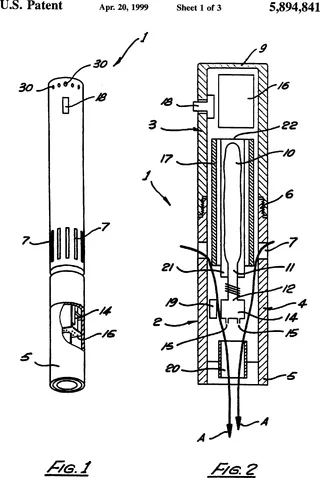
A dispenser (FIG. 1, 1) comprises a reservoir (10) of a physiologically active substance and a droplet ejection device (14), for example a bubble jet or pizeoelectric device, which is controlled to issue a predetermined number of discrete droplets of the substance from ejection orifices (15) upon actuation. Device (14) may be actuated by a pressure transducer (19) responsive to inhalation and issue the droplets into an airstream (A) which enters at slot (7) and is then inhaled via mouthpiece (5). In other embodiments (FIG. 5) the dispenser is finger actuated and directed by hand for topical application. The number and/or frequency of droplets issued is programmatically controlled by a control circuit (16) whereby average and total dose of the substance are predetermined.
Philip Morris Inc1999
74citas
77 % del 1.º (96)De qué trata · original en inglés
Methods and apparatuses for cleaning an electrical lighter are provided. A sleeve, e.g., ceramic or metal, surrounds the heater fixture, and a resistive heating element is in thermal proximity with the sleeve. The resistive heating element is either a dedicated element or the cigarette heating elements. The sleeve serves as a aerosol barrier and condensate accumulator to protect other components. Periodically, e.g., substantially contemporaneously with a battery recharge, the heating element is activated to thermally liberate condensates deposited on the sleeve during smoking and also heats, and thereby cleans, other components. Also, a cleaning element is optionally inserted into the cigarette receptacle of the electrical lighter or placed at the exit thereof to absorb, attract and/or catalytically break down the thermally liberated condensates. The sleeve also directs a desired flow path for drawn air within an electrical lighter toward the cigarette.
Inventores independientes2013
74citas
77 % del 1.º (96)De qué trata · original en inglés
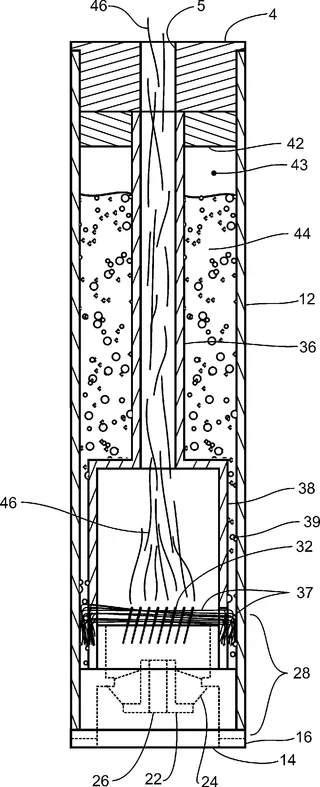
An electronic cigarette including an elongated housing that has a mouthpiece with an aerosol outlet, and an atomizer disposed within an atomizing chamber. The atomizer selectively generates an aerosol of the liquid in response to suction pressure at the aerosol outlet. The atomizing chamber has an air inlet, an atomizer outlet coupled to the aerosol outlet, and a first wick aperture. A liquid reservoir is disposed within the elongated housing, which is sealably separated from the atomizing chamber. A wick disposed through the first wick aperture between the liquid reservoir and the atomizing chamber and it is configured to transfer the liquid by capillarity from the liquid reservoir to the atomizer.











 Tecnología médica

 Maquinaria eléctrica y energía

 Muebles y juegos
 Tecnología informática

 Tecnología audiovisual

 Máquinas textiles y de papel

 Otras máquinas especiales