





Citation
When a new patent lists an older one as a reference. More citations = more influence.
WIPO technology field · 2025
The 32 patent applications (not yet granted) that served most often as references for new inventions in this field.
Published applications are still under review: they may be granted, amended or rejected — but they already influence new inventions.
When a new patent lists an older one as a reference. More citations = more influence.
The U.S. Patent Office reviewer. Cites what is too similar to the application.
too similarThe company or inventor filing the patent. Cites what inspired their work.
inspirationThe inventions the Patent Office used most for comparison — the closest to what is being patented today.
Highlights
SABIC Global Technologies BV 2019
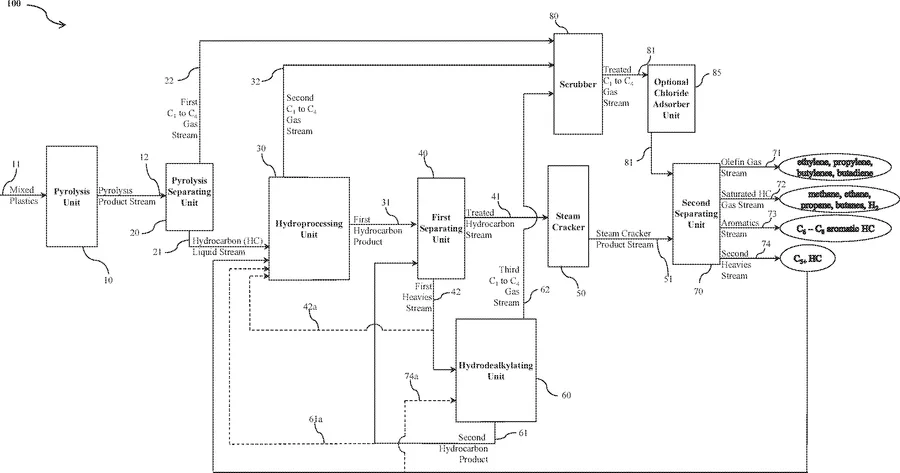
6 inventors: Ravichander Narayanaswamy, Krishna Kumar Ramamurthy and 4 moreA process for processing plastic waste comprising converting plastic waste to hydrocarbon liquid and a first C 1-4 gas; contacting hydrocarbon liquid with a first hydroprocessing catalyst in hydroprocessing unit to yield a second C 1-4 gas and a first hydrocarbon product comprising C 5 + liquid hydrocarbons; introducing the first hydrocarbon product to a first separating unit to produce treated hydrocarbon stream comprising C 5-8 hydrocarbons and a first heavies stream comprising C9+ hydrocarbons; contacting the first heavies stream with a second hydroprocessing catalyst in hydrodealkylating unit to yield a second hydrocarbon product comprising C 5 + liquid hydrocarbons and a third C 1-4 gas; conveying the second hydrocarbon product to the first separating unit; feeding treated hydrocarbon stream to steam cracker to produce steam cracker product; separating steam cracker product into olefin gas, saturated hydrocarbons gas, aromatics, and a second heavies stream; and conveying the second heavies stream to hydroprocessing unit.
7citations
Independent inventors 2002
2 inventors: Xiao Li and 1 more7citations
Universal Display Corp 2010
3 inventors: Chuanjun Xia and 2 moreFull ranking
Each number shows how many times the patent was used as a reference by new U.S. patents granted in 2025. Tap any of them to see the drawing, who invented it and what it does.
SABIC Global Technologies BV2019
9citations
Top of the listWhat it does
A process for processing plastic waste comprising converting plastic waste to hydrocarbon liquid and a first C 1-4 gas; contacting hydrocarbon liquid with a first hydroprocessing catalyst in hydroprocessing unit to yield a second C 1-4 gas and a first hydrocarbon product comprising C 5 + liquid hydrocarbons; introducing the first hydrocarbon product to a first separating unit to produce treated hydrocarbon stream comprising C 5-8 hydrocarbons and a first heavies stream comprising C9+ hydrocarbons; contacting the first heavies stream with a second hydroprocessing catalyst in hydrodealkylating unit to yield a second hydrocarbon product comprising C 5 + liquid hydrocarbons and a third C 1-4 gas; conveying the second hydrocarbon product to the first separating unit; feeding treated hydrocarbon stream to steam cracker to produce steam cracker product; separating steam cracker product into olefin gas, saturated hydrocarbons gas, aromatics, and a second heavies stream; and conveying the second heavies stream to hydroprocessing unit.
Independent inventors2002
7citations
78% of 1st (9)What it does
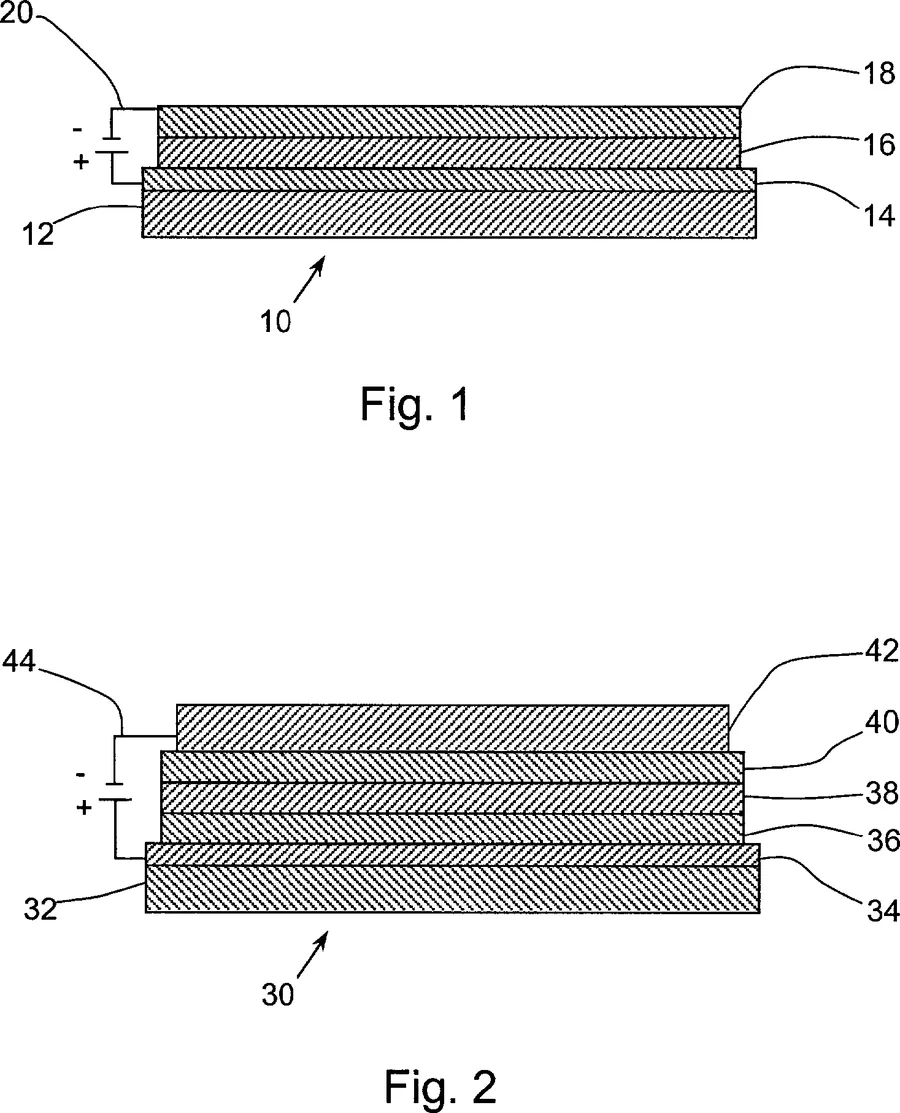
Organic semiconductors consisting of conjugated chromophores wherein one or more hydrogen atoms are deuterated are disclosed. Methods of preparing such organic semiconductors are described. The organic semiconducting compounds exhibit remarkably high luminescence and good thermal stability. Applications of these materials for optoelectronic devices, such as light-emitting devices and photodiodes, with enhanced performance and lifetime are disclosed. The disclosed materials can be used as emissive layer, charge-transporting layer, or energy transfer (i.e. phosphorescence dopant) material in organic light-emitting devices.
Universal Display Corp2010
7citations
78% of 1st (9)What it does
Novel organic compounds comprising ligands with deuterium substitution are provided. In particular, the compound is an iridium complex comprising methyl-d 3 substituted ligands. The compounds may be used in organic light emitting devices to provide devices having improved color, efficiency and lifetime.
SABIC Global Technologies BV2016
7citations
78% of 1st (9)What it does
A robust integrated process for the conversion of waste plastics to high value products. The robust integrated process allows for operation with a single hydroprocessing reactor which provides simultaneous hydrogenation, dechlorination, and hydrocracking of components of a hydrocarbon stream to specifications which meet steam cracker requirements, with the option to further dechlorinate the treated hydrocarbon stream in a polishing zone.
Saudi Arabian Oil Co2018
7citations
78% of 1st (9)What it does
Process scheme configurations are disclosed that enable conversion of crude oil feeds with several processing units in an integrated manner into petrochemicals. The designs utilize minimum capital expenditures to prepare suitable feedstocks for the steam cracker complex. The integrated process for converting crude oil to petrochemical products including olefins and aromatics, and fuel products, includes mixed feed steam cracking and gas oil steam cracking. Feeds to the mixed feed steam cracker include light products and naphtha from hydroprocessing zones within the battery limits, recycle streams from the C3 and C4 olefins recovery steps, and raffinate from a pyrolysis gasoline aromatics extraction zone within the battery limits. Feeds to the gas oil steam cracker include gas oil range intermediates from the vacuum gas oil hydroprocessing zone. Furthermore, vacuum residue is processed in a delayed coker unit to produce coker naphtha, which is hydrotreated and passed as additional feed to aromatics extraction zone and/or the mixed feed steam cracker, and coker gas oil range intermediates as additional feed to the gas oil hydroprocessing zone.
Independent inventors2002
5citations
56% of 1st (9)What it does
A light emitting device is provided which has a structure for lowering energy barriers at interfaces between layers of a laminate organic compound layer. A mixed layer ( 105 ) composed of a material that constitutes an organic compound layer ( 1 ) ( 102 ) and a material that constitutes an organic compound layer ( 2 ) ( 103 ) is formed at the interface between the organic compound layer ( 1 ) ( 102 ) and the organic compound layer ( 2 ) ( 103 ). The energy barrier formed between the organic compound layer ( 1 ) ( 102 ) and the organic compound layer ( 2 ) ( 103 ) thus can be lowered.
Unilever Home and Personal Care USA2003
5citations
56% of 1st (9)What it does
The invention provides disintegrant granules and a tablet of compacted particulate detergent composition comprising non-soap surfactant and detergency builder, wherein the tablet or a discrete region thereof comprises disintegrant granules comprising a water-swelling clay, a water-insoluble inorganic material and a water-swellable agent. The inorganic material is preferably silica or a crystalline aluminosilicate. The tablets show good disintegration properties, even upon storage. Especially good disintegration is obtained for tablets comprising disintegrant granules which comprise the water-swellable agent, which in its anhydrous state, comprises no more than 20% by weight of the combined weight of the swelling clay, the inorganic material and the water-swellable agent. A method of making the tablets is also provided.
Independent inventors2008
5citations
56% of 1st (9)What it does
Systems and methods for processing hydrocarbons are provided. A hydrocarbon can be distilled to provide a distillate, a gas oil, and a residue. The residue can include, but is not limited to asphaltenes and non-asphaltenes. The residue can be mixed with a solvent to provide a mixture. The asphaltenes can be selectively separated from the mixture to provide a deasphalted oil. At least a portion of the deasphalted oil and at least a portion of the gas oil can be hydroprocessed to provide a hydroprocessed hydrocarbon. At least a portion of the distillate and at least a portion of the hydroprocessed hydrocarbon can be cracked in a first reaction zone to provide a first cracked product comprising C2 hydrocarbons, C3 hydrocarbons, C4 hydrocarbons, and naphtha.
Canon Inc2010
5citations
56% of 1st (9)What it does
Provided is an organic metal complex having a structure represented by the following general formula (1): ML m L′ n (1) where: M represents a metal atom selected from Ir, Pt, Rh, Os, and Zn; L and L′, which are different from each other, each represent a bidentate ligand; m represents an integer of 1 to 3 and n represents an integer of 0 to 2, provided that m+n is 3; a partial structure ML m represents a structure represented by the following general formula (2): and a partial structure ML′ n represents a structure including a monovalent bidentate ligand.
Universal Display Corp2010
5citations
56% of 1st (9)What it does
Triphenylene containing benzo-fused thiophene compounds are provided. Additionally, triphenylene containing benzo-fused furan compounds are provided. The compounds may be useful in organic light emitting devices, particularly as hosts in the emissive layer of such devices, or as materials for enhancement layers in such devices, or both.
Halliburton Energy Services Inc2015
5citations
56% of 1st (9)What it does
A method of cementing a subterranean formation includes providing a cement composition comprising cementitious material, aqueous base fluid, graphene nano-platelets, and a dispersant; introducing the cement composition into a subterranean formation; and allowing the cement composition to set in the subterranean formation. Upon setting, the cement has at least one of enhanced compressive and tensile strength; reduced permeability; restricted penetration of carbon dioxide; and combinations thereof relative to an equivalent cement without graphene nano-platelets. Cement compositions include cementitious material, an aqueous base fluid, graphene nano-platelets, and a dispersant.
JNC Corp2015
5citations
56% of 1st (9)What it does
A novel polycyclic aromatic compound in which plural aromatic rings are linked via boron atoms, oxygen atoms and the like is provided, and therefore, the range of selection of the material for organic electroluminescent elements can be widened. Also, an excellent organic electroluminescent element is provided by using the novel polycyclic aromatic compound as a material for an organic electroluminescent element.
Transtar Group Ltd2016
5citations
56% of 1st (9)What it does
Eco-friendly systems, methods and processes/processing (EFSMP) or an integrated Matrix encompasses stand-alone and/or interconnected modules for completely self-sustained, closed-loop, emission-free processing of multiple source feedstock that can include pretreatment, with poisoning materials isolated during pretreatment being further recycled to provide useful materials such as, for example, separated metals, carbon and fullerenes for production of nano materials, sulfur, water, sulfuric acid, gas, heat and carbon dioxide for energy production, and production of refined petroleum, at a highly-reduced cost over the best state-of-the-art refining methods/systems that meets new emissions standards as well as optimizes production output with new ultra-speed cycle times. By-products from the petroleum refining process which were previously discarded also now are recycled as renewable sources of energy (water, waste oil and rubber/coal derived pyrolyic (pyrolysis) oil, carbon gases and process gases), or recyclable resources, such as metals and precious metals, oxides, minerals, etc., can be obtained.
Samsung Display Co Ltd2016
5citations
56% of 1st (9)What it does
An organic light-emitting device includes a first electrode; a second electrode facing the first electrode; an emission layer between the first electrode and the second electrode; and a hole transport region between the first electrode and the emission layer. The emission layer includes an organometallic compound represented by Formula 1, and the hole transport region includes a first compound represented by Formula 2.
International Flavors and Fragrances Inc2018
5citations
56% of 1st (9)What it does
A microcapsule composition is provided, which contains a polyurea or polyurethane microcapsule, an alkylnaphthalenesulfonate formaldehyde condensate, and polyvinylpyrrolidone. Also disclosed is a process of preparing the microcapsule composition and a consumer product having such a microcapsule composition.
Saudi Arabian Oil Co2018
5citations
56% of 1st (9)What it does
Systems and methods of integrated gas oil separation are disclosed. Systems include a high pressure production trap (HPPT), a low pressure production trap (LPPT), a low pressure degassing tank (LPDT), a first knockout drum (KOD) fluidly coupled to the LPDT and operable to accept an atmospheric pressure off-gas from the LPDT, an atmospheric pressure compressor fluidly coupled to the first KOD and operable to compress the atmospheric pressure off-gas to introduce the atmospheric pressure off-gas from the LPDT into the LPPT inlet feed stream, a second KOD fluidly coupled to the LPPT and operable to accept a low pressure off-gas from the LPPT, and a low pressure compressor fluidly coupled to the second KOD and operable to compress the low pressure off-gas to introduce the low pressure off-gas from the LPPT into the crude oil inlet feed stream.
Independent inventors2019
5citations
56% of 1st (9)What it does
This patent disclosure includes a process that uniquely and unexpectedly results in the production of extremely high specific surface area and large pore volume carbon nanomaterial with high content of sp2 hybridized carbon-carbon in the form of nanosheets from a renewable carbonaceous raw material. The resulting nanomaterial is in particulate form or porous nanomaterial or dispersed in solvent. This process can also be used to produce carbon nanosheet on substrates or form a nanocomposite with other materials that results in exceptional properties.
Saudi Arabian Oil Co2019
5citations
56% of 1st (9)What it does
Systems and processes are disclosed for producing petrochemical products, such as ethylene, propene and other olefins from crude oil in high severity fluid catalytic cracking (HSFCC) units. Processes include separating a crude oil into a light fraction and a heavy fraction, cracking the light fraction and heavy fraction in separation cracking reaction zones, and regenerating the cracking catalysts in a two-zone regenerator having a first regeneration zone for the first catalyst (heavy fraction) and a second regeneration zone for the second catalyst (light fraction) separate from the first regeneration zone. Flue gas from the first catalyst regeneration zone is passed to the second regeneration zone to provide additional heat to raise the temperature of the second catalyst of the light fraction side. The disclosed systems and processes enable different catalysts and operating conditions to be utilized for the light fraction and the heavy fraction of a crude oil feed.
Material Science Co Ltd2021
5citations
56% of 1st (9)What it does
The present disclosure relates to an organic electroluminescent element, and more particularly to an organic electroluminescent element including a novel boron-based organic compound and anthracene-based organic compound in one or more organic layers included in the organic electroluminescent element. The present disclosure may provide an organic electroluminescent element, which is prevented from deterioration in color characteristics and has characteristics such as long lifetimes, as a result of using a host material having a specific structural formula despite having high polarity.
Xi'an Modern Chemistry Research Institute2023
5citations
56% of 1st (9)What it does
Disclosed are a liquid crystal (LC) composition and a high-frequency component including the same. The LC composition includes one or more selected from compounds shown in structural formula (I) and one or more selected from compounds shown in structural formula (II):where R1 is selected from alkyl with 1 to 10 carbon atoms, alkenyl with 2 to 10 carbon atoms, fluorinated alkyl, fluorinated alkenyl, and cycloalkyl; one of X1, X2, and X3 is methyl or chlorine, and the other two are hydrogen; k, m, n, and p are 0 or 1; and ring A is selected from a benzene ring, cyclohexane, and cyclohexene;where R2 and R3 each are selected from alkyl with 1 to 10 carbon atoms, alkenyl with 2 to 10 carbon atoms, fluorinated alkyl, fluorinated alkenyl, cycloalkyl, halogen, and NCS; and ring A and ring B each are selected from a benzene ring, cyclohexane, and cyclohexene.
The inventions companies themselves named as the foundation of their work — the market’s references.
Highlights
Independent inventors 2003
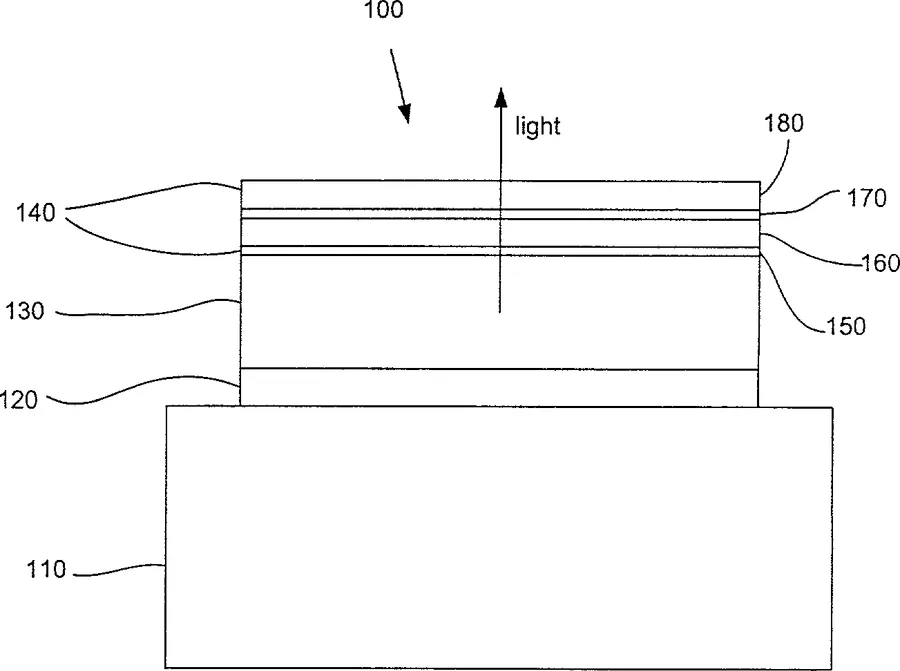
2 inventors: Stephen R. Forrest and Martin PfeifferAbstract of the Disclosure An organic light emitting device is provided, having a p-doped organic layer, an n-doped layer, and a phosphorescent emissive layer disposed between the p-doped and n-doped layers. Blocking layers are used to confine electrons, holes, and excitons in the emissive layer. A device having a cathode on the top is provided, as well as an "inverted"device having a cathode on the bottom.
78citations
Independent inventors 2004
2 inventors: Min-Hao Michael Lu and 1 more72citations
Fuji Photo Film Co Ltd 2006
Inventor: Toshihiro IseFull ranking
Each number shows how many times the patent was used as a reference by new U.S. patents granted in 2025. Tap any of them to see the drawing, who invented it and what it does.
Independent inventors2003
78citations
Top of the listWhat it does
Abstract of the Disclosure An organic light emitting device is provided, having a p-doped organic layer, an n-doped layer, and a phosphorescent emissive layer disposed between the p-doped and n-doped layers. Blocking layers are used to confine electrons, holes, and excitons in the emissive layer. A device having a cathode on the top is provided, as well as an "inverted"device having a cathode on the bottom.
Independent inventors2004
78citations
Top of the listWhat it does
A cathode adapted for use in an organic optoelectronic device is provided. The cathode has an electron injection layer, an organic buffer layer, a conducting layer, and a transparent conductive oxide layer disposed, in that order, over the organic operative layers of the optoelectronic device. A method of fabricating the cathode is also provided.
Fuji Photo Film Co Ltd2006
72citations
92% of 1st (78)What it does
An organic electroluminescent device having a pair of electrodes and at least one organic layer interposed between the pair of electrodes, in which the at least one organic layer contains at least one compound represented by formula (I): wherein, Z 1 and Z 2 each independently represent a nitrogen-containing aromatic six-membered ring coordinated to the platinum through a nitrogen atom; Q 1 represents a group of atoms necessary for forming, together with the —C—C—, a nitrogen-containing aromatic five-membered ring; L 1 represents a single bond or a divalent linking group; and n is 0 or 1.
Independent inventors2003
71citations
91% of 1st (78)What it does
The present invention relates to efficient organic light emitting devices (OLEDs). More specifically, the present invention relates to white-emitting OLEDs, or WOLEDs. The devices of the present invention employ two emitters in a single emissive region to sufficiently cover the visible spectrum. White emission is achieved from two emitters in a single emissive region through the formation of an aggregate by one of the emissive centers. This allows the construction of simple, bright and efficient WOLEDs that exhibit a high color rendering index.
BASF SE2008
71citations
91% of 1st (78)What it does
The present invention relates to the use of transition metal-carbene complexes in organic light-emitting diodes (OLEDs), to a light-emitting layer, to a blocking layer for electrons or excitons, or to a blocking layer for holes, each comprising these transition metal-carbene complexes, to OLEDs comprising these transition metal-carbene complexes, to devices which comprise an inventive OLED, and to transition metal-carbene complexes.
Idemitsu Kosan Co Ltd2008
71citations
91% of 1st (78)What it does
An aromatic amine derivative with a specific structure having a carbazole skeleton to which a diarylamino group bonds via a bonding group. An organic electroluminescence device which is composed of one or more organic thin film layers including at least one light emitting layer sandwiched between a cathode and an anode, wherein at least one of the organic thin film layers contains the aromatic amine derivative singly or as its mixture component. Organic electroluminescence devices with enhanced efficiency of light emission and a compound realizing the devices are provided.
Independent inventors2002
69citations
88% of 1st (78)What it does
Organic light emitting devices are described wherein the emissive layer comprises a host material containing an emissive molecule, which molecule is adapted to luminesce when a voltage is applied across the heterostructure, and the emissive molecule is selected from the group of phosphorescent organometallic complexes, including cyclometallated platinum, iridium and osmium complexes. The organic light emitting devices optionally contain an exciton blocking layer. Furthermore, improved electroluminescent efficiency in organic light emitting devices is obtained with an emitter layer comprising organometallic complexes of transition metals of formula L 2 MX, wherein L and X are distinct bidentate ligands. Compounds of this formula can be synthesized more facilely than in previous approaches and synthetic options allow insertion of fluorescent molecules into a phosphorescent complex, ligands to fine tune the color of emission, and ligands to trap carriers.
Fuji Photo Film Co Ltd2005
69citations
88% of 1st (78)What it does
An organic electroluminescent device including a pair of electrodes, and at least one organic layer including a luminescent layer between the pair of electrodes, in which the organic electroluminescent device includes at least one compound selected from the group consisting of the compounds represented by Formula (1), (2) and (3):
Idemitsu Kosan Co Ltd2007
69citations
88% of 1st (78)What it does
Provided are a novel aromatic amine derivative having a specific structure and an organic electroluminescence device in which an organic thin layer comprising a single layer or plural layers including a light emitting layer is interposed between a cathode and an anode, wherein at leas one layer of the above organic thin layer contains the aromatic amine derivative described above in the form of a single component or a mixed component. Thus, the organic electroluminescence device is less liable to be crystallized in molecules, improved in a yield in producing the organic electroluminescence device and extended in a lifetime.
Idemitsu Kosan Co Ltd2009
68citations
87% of 1st (78)What it does
A material for organic electroluminescence devices of the invention which is for use in combination with at least one phosphorescent metal complex has a specific heterocyclic structure. The material for organic electroluminescence devices is used as a host material or a hole transporting material. An organic electroluminescence device having an anode, a cathode and an organic thin film layer having one or more layers which is interposed between the anode and cathode, in which at least one layer of the organic thin film layer contains the material for organic electroluminescence devices, has a high emitting efficiency, causes little pixel defects, is excellent in heat resistance, and shows a long lifetime.
Idemitsu Kosan Co Ltd2009
68citations
87% of 1st (78)What it does
A material for organic electroluminescence devices for use as a host material in combination with at least one phosphorescent metal complex, which comprises a compound having a specific heterocyclic structure, is described. Also described is an organic electroluminescence device having an anode, a cathode and an organic thin film layer having one or more layers. The organic thin film layer is interposed between the anode and cathode and has a light emitting layer containing a host material in combination with at least one phosphorescent metal complex. At least one layer of the organic thin film layer contains the material for organic electroluminescence devices. The material for organic electroluminescence devices provides an organic electroluminescence device which has a high emitting efficiency, causes little pixel defects, is excellent in heat resistance, and show a long lifetime.
Canon Inc2009
68citations
87% of 1st (78)What it does
An organometallic complex and an organic light-emitting element containing the complex which has a very high efficiency, a high luminance, and durability. The organic light-emitting element has an anode, a cathode, and a layer including an organic compound sandwiched between the anode and cathode. The layer containing the organic compound includes at least one organometallic complex represented by General Formula [I] below.







 Macromolecular chemistry and polymers

 Organic fine chemistry

 Semiconductors

 Surface technology and coating

 Other special machines

 Chemical engineering

 Materials and metallurgy