





Cita
Cuando una patente nueva menciona otra anterior como referencia. Más citas = más influencia.
Basic Materials Chemistry · 2025
Las 23 patentes que más han servido de referencia para los nuevos inventos del área.
Cuando una patente nueva menciona otra anterior como referencia. Más citas = más influencia.
El evaluador de la Oficina de Patentes de EE. UU. Cita lo que se parece demasiado a la solicitud.
demasiado parecidaLa empresa o el inventor que pide la patente. Cita lo que le sirvió de inspiración.
fuente de inspiraciónLos inventos que la Oficina más usó como comparación: los más parecidos a lo que se patenta hoy.
Destacados
Atrion Medical Products Inc 2006
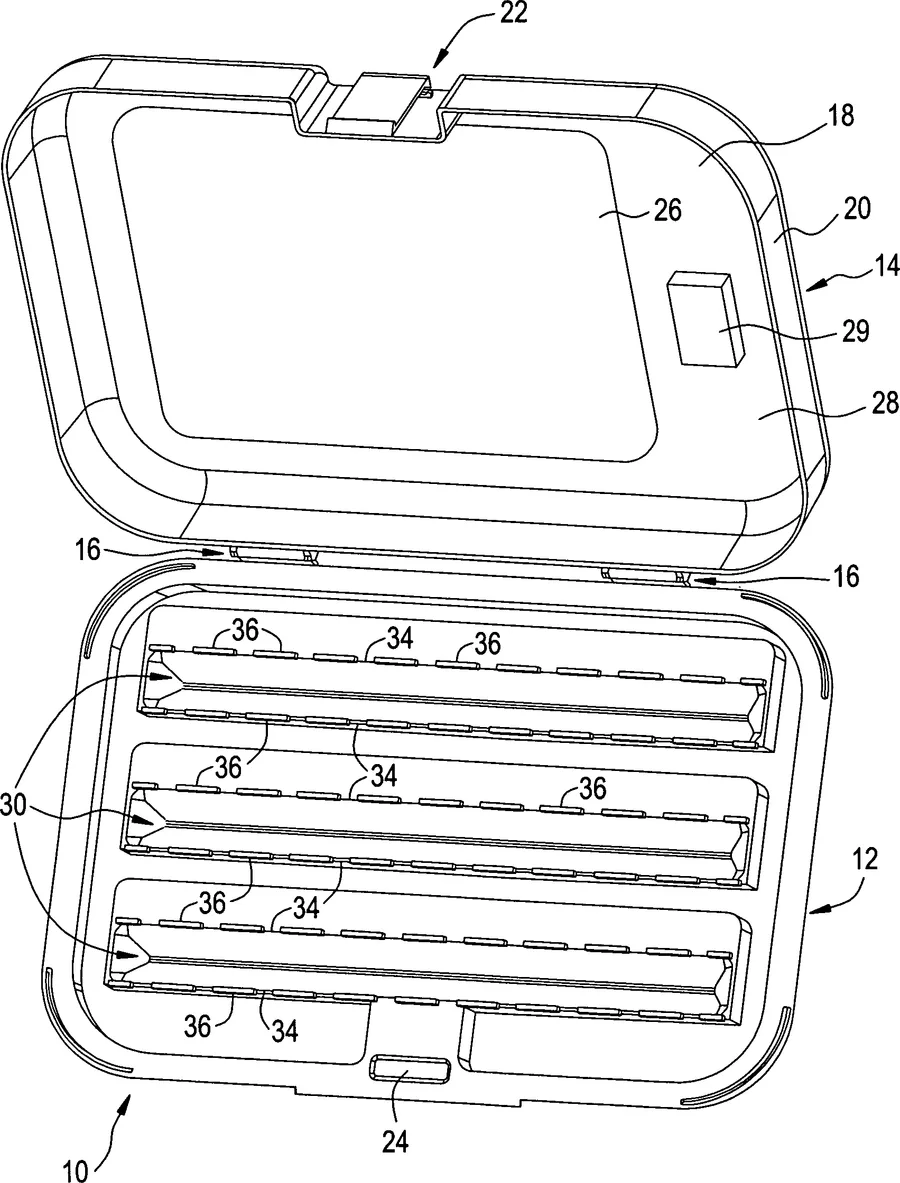
2 inventores: Rowland W. Kanner y Larry Lee YoungA needle counter device which utilizes an adhesive disposed in one or more, preferably V-shaped, troughs. The adhesive provides instant, strong grip upon contact, but also provides very low resistance to needle penetration (i.e., it is easy to stick a needle in the adhesive, but difficult to pull the needle out). The device includes a base and a lid, and opens and closes much like a book. Once the device is closed, the device tends to remain closed unless intentionally opened. A thin layer of adhesive may be provided on the inside of the lid, to retain used surgical blades, and a piece of resilient foam may also be provided for temporarily “parking” a suture needle. The sides of each trough are lined with structure which serves to prevent an accidentally laid surgical instrument from unintentionally contacting the adhesive. Numerical indices provide a quick visual, counting assist. Double sticky tape, covered with a protective peel away release sheet, can be provided on the outside surface of the lid and/or the base, for adhering the device to work surfaces.
5citas
UOP LLC 1999
2 inventores: Tom N. Kalnes y 1 más4citas
Iogen Corp 2022
2 inventores: Patrick J. Foody y 1 másClasificación completa
Cada número indica cuántas veces la patente sirvió de referencia para nuevas patentes concedidas en EE. UU. en 2025. Toca cualquiera para ver el dibujo, quién la inventó y de qué trata.
Atrion Medical Products Inc2006
8citas
Líder de la listaDe qué trata · original en inglés
A needle counter device which utilizes an adhesive disposed in one or more, preferably V-shaped, troughs. The adhesive provides instant, strong grip upon contact, but also provides very low resistance to needle penetration (i.e., it is easy to stick a needle in the adhesive, but difficult to pull the needle out). The device includes a base and a lid, and opens and closes much like a book. Once the device is closed, the device tends to remain closed unless intentionally opened. A thin layer of adhesive may be provided on the inside of the lid, to retain used surgical blades, and a piece of resilient foam may also be provided for temporarily “parking” a suture needle. The sides of each trough are lined with structure which serves to prevent an accidentally laid surgical instrument from unintentionally contacting the adhesive. Numerical indices provide a quick visual, counting assist. Double sticky tape, covered with a protective peel away release sheet, can be provided on the outside surface of the lid and/or the base, for adhering the device to work surfaces.
UOP LLC1999
5citas
63 % del 1.º (8)De qué trata · original en inglés
A process for the simultaneous conversion of waste lubricating oil and pyrolysis oil derived from organic waste to produce a synthetic crude oil by means of contacting the combined feed with a hot hydrogen-rich gaseous stream to increase the temperature of the combined feed to vaporize at least a portion of the distillable organic compounds contained therein which is immediately hydrogenated in a hydrogenation reaction zone. The resulting effluent from the hydrogenation reaction zone is then introduced into a hydroprocessing zone to produce higher hydrogen-content hydrocarbons and to remove heterogeneous components such as sulfur, oxygen, nitrogen and halide, for example. The resulting effluent is cooled and partially condensed to produce a gaseous stream containing hydrogen and gaseous water-soluble inorganic compounds and a liquid stream containing hydrocarbon compounds. The gaseous stream is scrubbed to remove the gaseous water-soluble organic compounds and to thereby produce a hydrogen-rich gaseous recycle stream.
Iogen Corp2022
4citas
50 % del 1.º (8)De qué trata · original en inglés
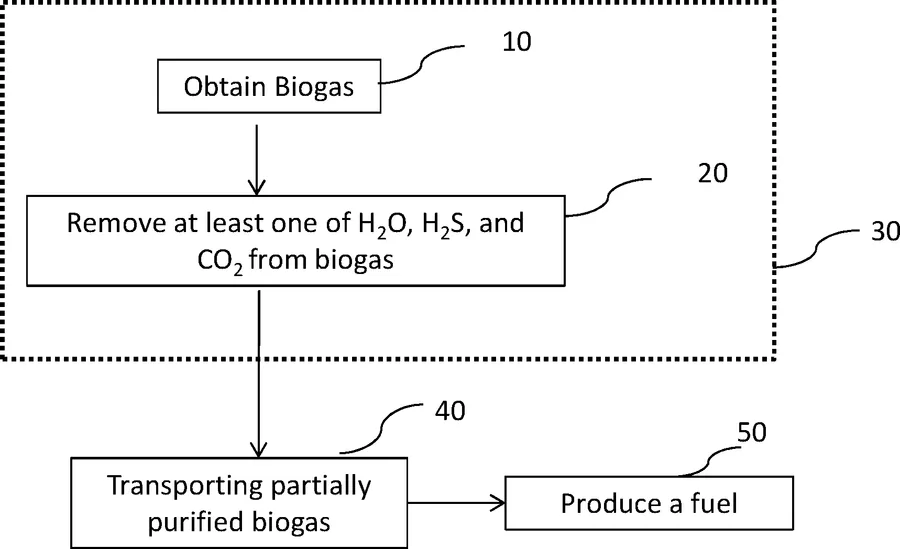
A method for providing a fuel includes providing a partially purified biogas at a first processing site, where the partially purified biogas is produced by multiple biogas sources and/or from multiple feedstock sources. The partially purified biogas is compressed, fed to a mobile tank, and transported by vehicle to a second processing site. At the second processing site, which may also receive biogas from a plurality of biogas sources, the partially purified biogas is further processed to produce a fuel or fuel intermediate.
Covestro Netherlands BV2024
4citas
50 % del 1.º (8)De qué trata · original en inglés
The present invention relates to a multi-aziridine compound having: a) from 2 to 6 of the following structural units (A): (A) whereby R′, R″, R1, R2, R3 and R4 are as defined herein m is an integer from 1 to 6; b) one or more linking chains wherein each one of these linking chains links two of the structural units A; and c) a molecular weight in the range from 600 Daltons to 5000 Daltons. The multi-aziridine compound can be used for example for crosslinking of for example carboxylic acid functional polymers dissolved and/or dispersed in an aqueous medium.
Covestro Netherlands BV2025
4citas
50 % del 1.º (8)De qué trata · original en inglés
The present invention relates to a multi-aziridine compound having: ⋅a) from 2 to 6 of the following structural units (A): whereby R 1 is H, R 2 and R 4 are independently chosen from H or an aliphatic hydrocarbon group containing from 1-4 carbon atoms, R 3 is an aliphatic hydrocarbon group containing from 1-4 carbon atoms, R′═H or an aliphatic hydrocarbon group containing from 1 to 4 carbon atoms; R″ and R′″ are independently chosen from an aliphatic hydrocarbon group containing from 1 to 4 carbon atoms, a cycloaliphatic hydrocarbon group containing from 4 to 12 carbon atoms or an aromatic hydrocarbon group containing from 6 to 12 carbon atoms, b) one or more linking chains wherein each one of these linking chains links two of the structural units A; and c) a molecular weight in the range from 600 Daltons to 5000 Daltons.
Universal Oil Products Co1968
4citas
50 % del 1.º (8)Pullman Inc1970
4citas
50 % del 1.º (8)EI Du Pont de Nemours and Co1972
4citas
50 % del 1.º (8)De qué trata · original en inglés
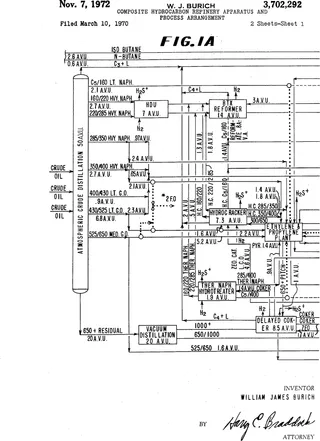
A HIGHLY INTEGRATED CRUDE OIL REFINERY ARRANGEMENT FOR PRODUCING FUEL AND CHEMICAL PRODUCTS, INVOLVING CRUDE OIL DISTILLATION MEANS, HYDROCRACKING MEANS, DELAYED COKING MEANS, REFORMING MEANS, ETHYLENE AND PROPYLENE PRODUCING MEANS COMPRISING A PYROLYSIS STEAM CRACKING UNIT AND A PYROLYSIS PRODUCTS SEPARATION UNIT, CATALYTIC CRACKING MEANS, AROMATIC PRODUCT RECOVERY MEANS, BUTADIENE RECOVERY MEANS AND ALKYLATION MEANS IN A HIGHLY FLEXIBLE, CLOSELY CONTROLLED AND INTER-RELATED SYSTEM TO PRODUCE A HIGH CONVERSION OF CRUDE OIL TO CHEMICALS OF AS HIGH AS ABOUT 50% AND A CONVERSION OF CRUDE OIL TO GASOLINE AND JET FUEL AS LOW AS ABOUT 50% FOR A MAXIMUM VALUE COMBINATION OF WIDELY VARIED PRODUCTS.
BP PLC1978
4citas
50 % del 1.º (8)De qué trata · original en inglés
This invention relates to a method of producing olefins from a wax distillate feed by cracking the feed in the presence of steam at a catalyst temperature of between 650° and 900° C over a manganese catalyst.
UOP LLC1985
4citas
50 % del 1.º (8)De qué trata · original en inglés
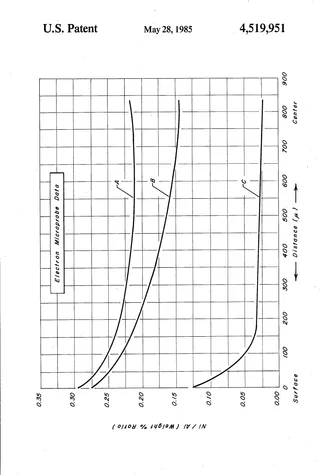
Substantial improvement in the selectivity of reduction of fatty materials may be obtained using as a catalyst a zerovalent Group VIII metal dispersed in an eggshell distribution on a porous support. When the catalyst is nickel on gamma-alumina it is possible to perform continuous reduction using a fixed catalyst bed with selectivities which equal or exceed that exhibited by conventional nickel catalysts used in a batch process.
Chevron USA Inc2000
4citas
50 % del 1.º (8)De qué trata · original en inglés
The invention includes a process of making a lubricating oil composition including: a process for making a high VI lubricating oil composition including the steps of (1) contacting a waste plastics feed including mainly polyethylene in a pyrolysis zone at pyrolysis conditions, whereby at least a portion of the waste plastics feed is cracked, thereby forming a pyrolysis zone effluent including 1-olefins and n-paraffins; (2) passing the pyrolysis zone effluent, including a heavy fraction and a middle fraction, the pyrolysis effluent middle fraction including 1-olefins, to a separations zone; where the pyrolysis effluent heavy fraction portion is separated from the pyrolysis effluent middle fraction; (3) passing the pyrolysis effluent heavy fraction to a hydrogenation zone; and (4) passing at least a portion of the hydrogenation zone effluent to a catalytic isomerization dewaxing zone, where at least a portion of the hydrogenation zone effluent is contacted with a isomerization dewaxing catalyst at isomerization dewaxing conditions thereby forming a high VI lubricating oil composition.
Membrane Technology and Research Inc2003
4citas
50 % del 1.º (8)De qué trata · original en inglés
A process for treating natural gas or other methane-rich gas to remove excess nitrogen. The invention relies on two-stage membrane separation, using methane-selective membranes for the first stage and nitrogen-selective membranes for the second stage. The process enables the nitrogen content of the gas to be substantially reduced, without requiring the membranes to be operated at very low temperatures.
Ellycrack AS2003
4citas
50 % del 1.º (8)De qué trata · original en inglés
A catalytic cracking process is described wherein the cracking takes place in a reactor under the influence of a rotating fluidized bed catalyst and compressed gases and/or steam is injected in order to effect movement of the catalyst bed.
Los inventos que las propias empresas señalaron como base de su trabajo: las referencias del mercado.
Destacados
Universal Display Corp 2007
4 inventores: Robert Walters, Jui-Yi Tsai y 2 másThe present invention relates to organic light emitting devices (OLEDs), and more specifically to phosphorescent organic materials used in such devices. More specifically, the present invention relates to emissive phosphorescent material which comprise at least one tridentate ligand bound to a metal center, wherein at least one of the bonds to the tridentate ligand is a carbon-metal bond.
86citas
Princeton University 2001
6 inventores: Mark E. Thompson y 5 más85citas
Princeton University 1998
3 inventores: Gong Gu y 2 másClasificación completa
Cada número indica cuántas veces la patente sirvió de referencia para nuevas patentes concedidas en EE. UU. en 2025. Toca cualquiera para ver el dibujo, quién la inventó y de qué trata.
Universal Display Corp2007
87citas
Líder de la listaDe qué trata · original en inglés
The present invention relates to organic light emitting devices (OLEDs), and more specifically to phosphorescent organic materials used in such devices. More specifically, the present invention relates to emissive phosphorescent material which comprise at least one tridentate ligand bound to a metal center, wherein at least one of the bonds to the tridentate ligand is a carbon-metal bond.
Princeton University2001
86citas
99 % del 1.º (87)De qué trata · original en inglés
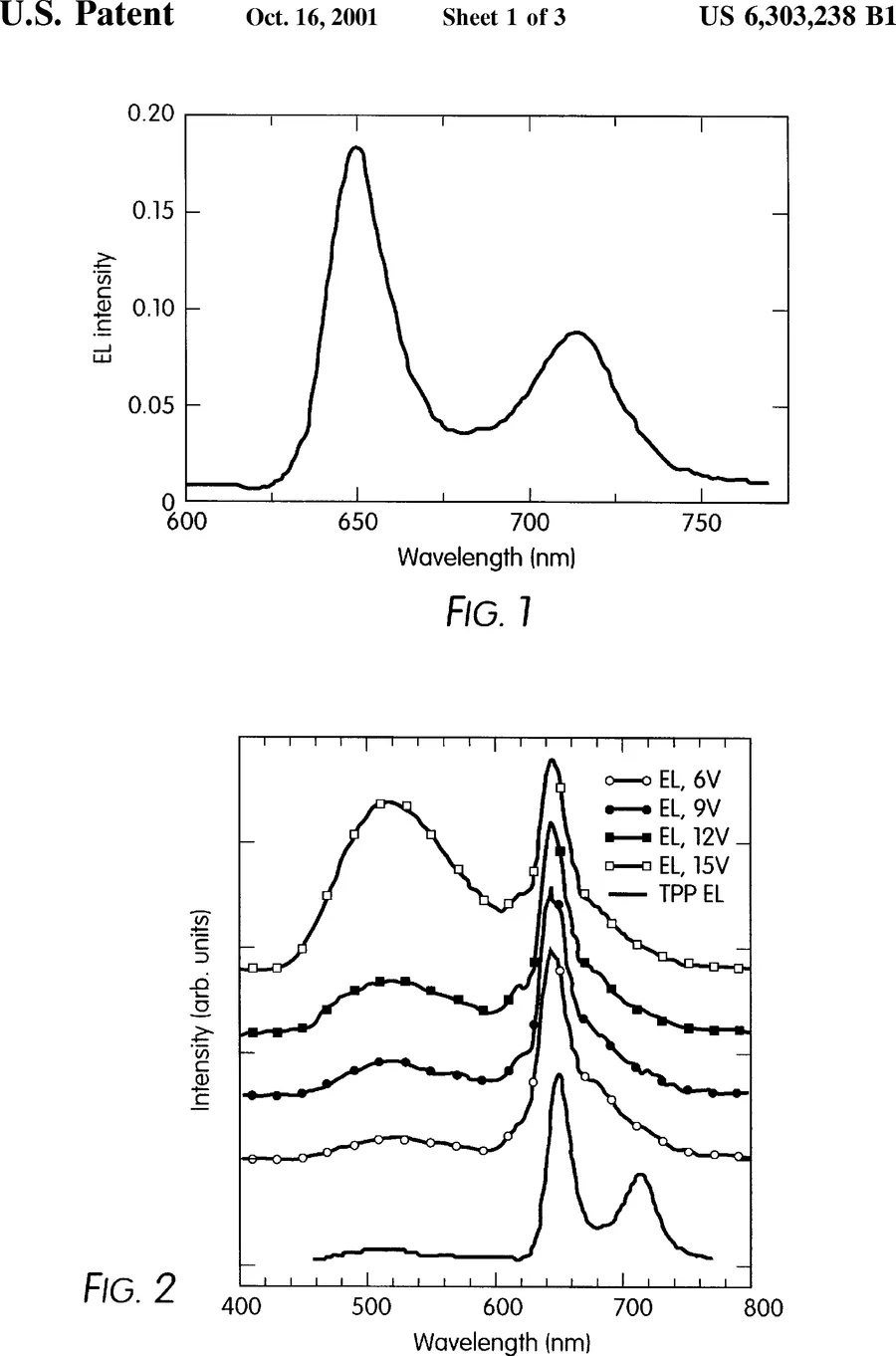
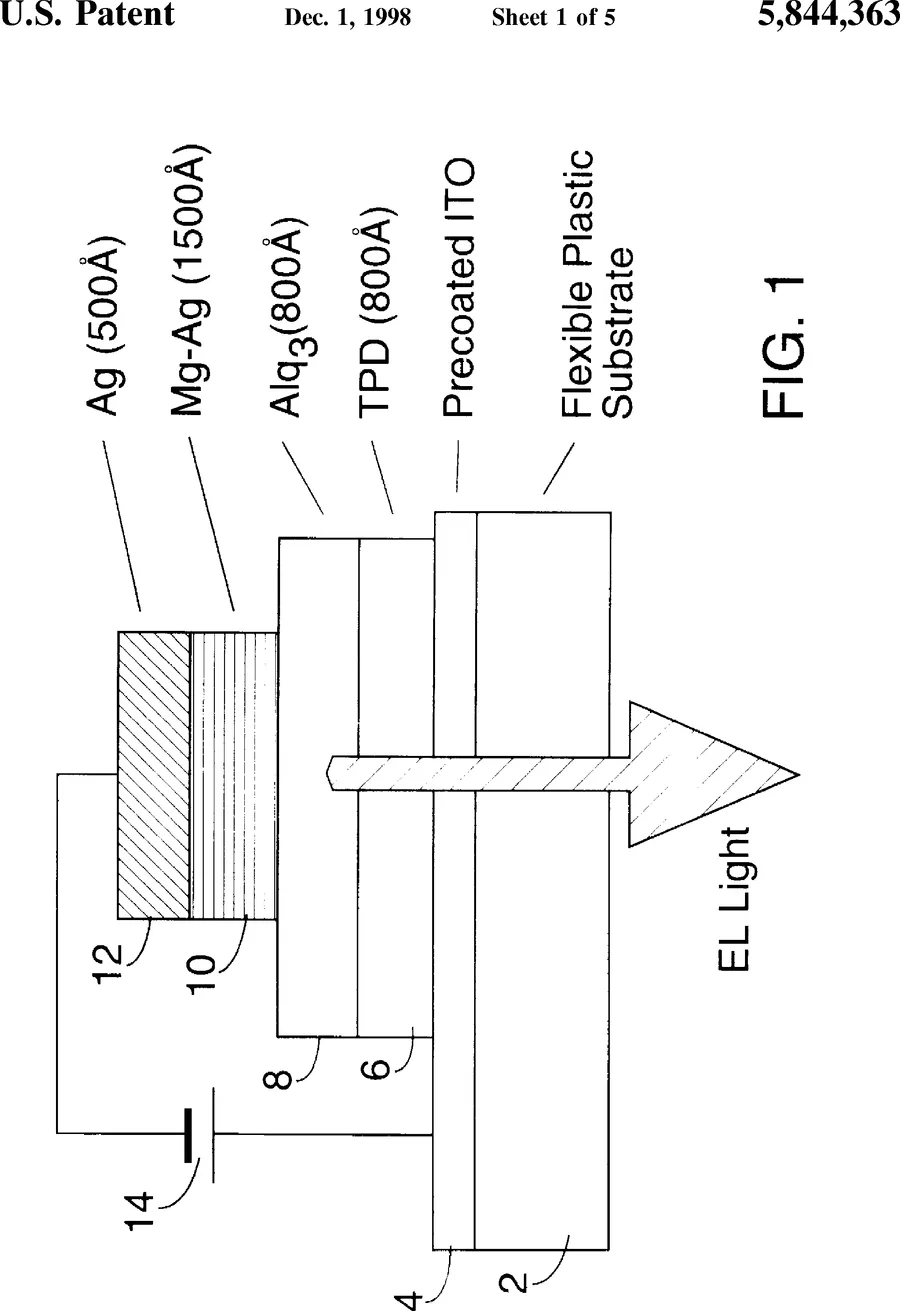
Organic light emitting devices are disclosed which are comprised of a heterostructure for producing electroluminescence wherein the heterostructure is comprised of an emissive layer containing a phosphorescent dopant compound. For example, the phosphorescent dopant compound may be comprised of platinum octaethylporphine (PtOEP), which is a compound having the chemical structure with the formula:
Princeton University1998
85citas
98 % del 1.º (87)De qué trata · original en inglés
An organic light emitting device (OLED) is disclosed for which the hole transporting layer, the electron transporting layer and/or the emissive layer, if separately present, is comprised of a non-polymeric material. A method for preparing such OLED's using vacuum deposition techniques is further disclosed.
Princeton University1998
83citas
95 % del 1.º (87)De qué trata · original en inglés
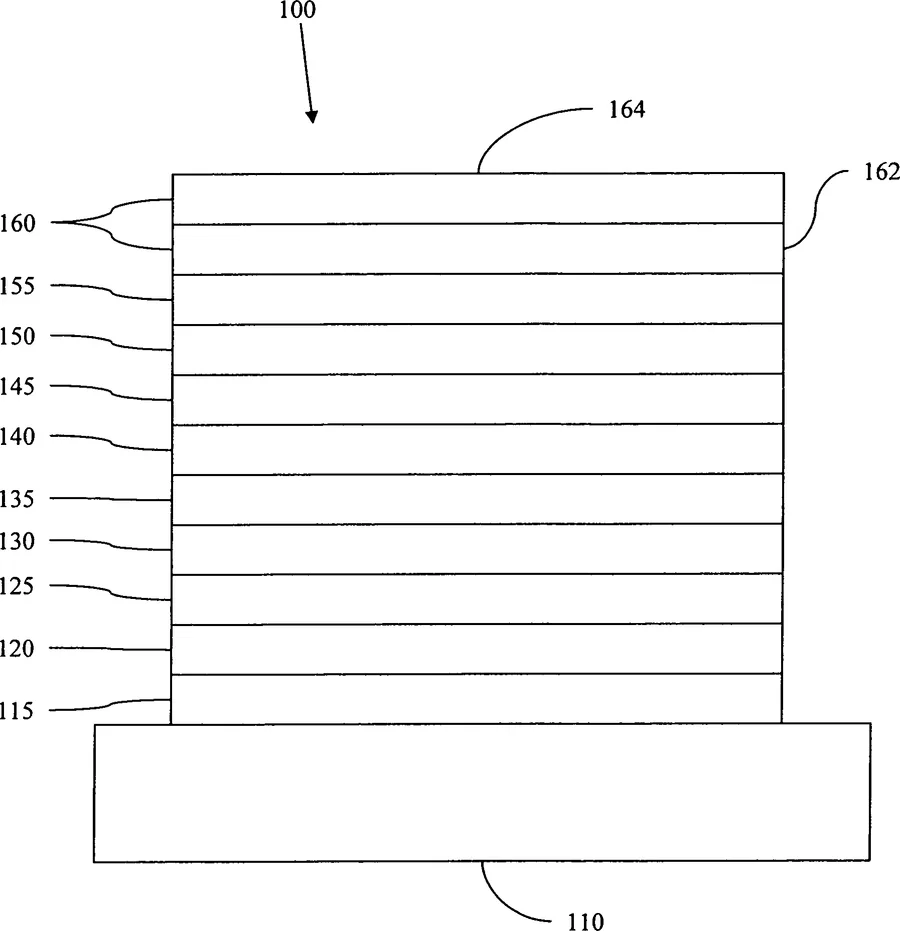
A multicolor organic light emitting device employs vertically stacked layers of double heterostructure devices which are fabricated from organic compounds. The vertical stacked structure is formed on a glass base having a transparent coating of ITO or similar metal to provide a substrate. Deposited on the substrate is the vertical stacked arrangement of three double heterostructure devices, each fabricated from a suitable organic material. Stacking is implemented such that the double heterostructure with the longest wavelength is on the top of the stack. This constitutes the device emitting red light on the top with the device having the shortest wavelength, namely, the device emitting blue light, on the bottom of the stack. Located between the red and blue device structures is the green device structure. The devices are configured as stacked to provide a staircase profile whereby each device is separated from the other by a thin transparent conductive contact layer to enable light emanating from each of the devices to pass through the semitransparent contacts and through the lower device structures while further enabling each of the devices to receive a selective bias.
Princeton University2000
79citas
91 % del 1.º (87)De qué trata · original en inglés
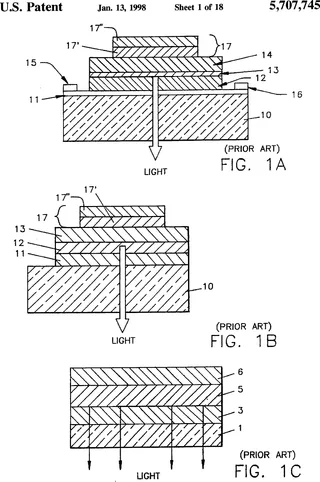
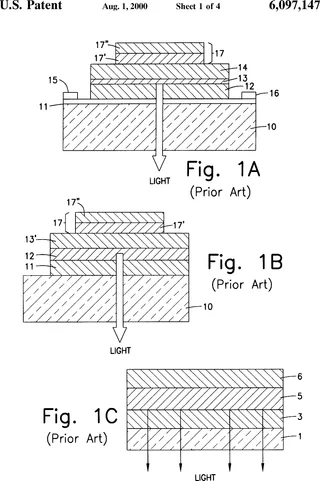
A light emitting device including a pixel having a substantially transparent anode; a hole transporting layer over the anode; an emission layer over the hole transporting layer; a blocking layer over the emission layer; an electron transporting layer over the blocking layer; and a cathode in electrical contact with the electron transporting layer.
Princeton University1997
78citas
90 % del 1.º (87)De qué trata · original en inglés
A multicolor organic light emitting device employs vertically stacked layers of double heterostructure devices which are fabricated from organic compounds. The vertical stacked structure is formed on a glass base having a transparent coating of ITO or similar metal to provide a substrate. Deposited on the substrate is the vertical stacked arrangement of three double heterostructure devices, each fabricated from a suitable organic material. Stacking is implemented such that the double heterostructure with the longest wavelength is on the top of the stack. This constitutes the device emitting red light on the top with the device having the shortest wavelength, namely, the device emitting blue light, on the bottom of the stack. Located between the red and blue device structures is the green device structure. The devices are configured as stacked to provide a staircase profile whereby each device is separated from the other by a thin transparent conductive contact layer to enable light emanating from each of the devices to pass through the semitransparent contacts and through the lower device structures while further enabling each of the devices to receive a selective bias. The devices are substantially transparent when de-energized, making them useful for heads-up display applications.
Eastman Kodak Co1991
77citas
89 % del 1.º (87)De qué trata · original en inglés
An internal junction organic electroluminescent device is disclosed comprising in sequence, an anode, an organic hold injecting and transporting zone, an organic electron injecting and transporting zone, and a cathode. The hole injecting and transporting zone includes a tertiary amine containing at least two tertiary amine moieties and including attached to a tertiary amine nitrogen atom an aromatic moiety containing at least two fused aromatic rings.
Eastman Kodak Co1988
75citas
86 % del 1.º (87)De qué trata · original en inglés
An electroluminescent device is disclosed having a luminescent zone of less than one μm in thickness comprised of an organic host material capable of sustaining hole-electron recombination and a fluorescent material capable of emitting light in response to energy released by hole-electron recombination.
Universal Display Corp2008
73citas
84 % del 1.º (87)De qué trata · original en inglés
An organic light emitting device is provided. The device has an anode, a cathode, and an organic layer disposed between the anode and the cathode. The organic layer comprises an emissive material having a transition metal and two or three bidentate ligands, which may be photoactive ligands. The bidentate photoactive ligands may be bound to the transition metal through a carbon-metal bond and a nitrogen-metal bond to form a cyclometallated ring. The organic layer may have the formula LX a -(L) b M, wherein X is a linking group that links two or more ligand L and M is a metal.
University of Southern California2008
70citas
80 % del 1.º (87)De qué trata · original en inglés
An organic light emitting device is provided. The device has an anode, a cathode and an organic layer disposed between the anode and the cathode. The organic layer comprises a compound further comprising one or more carbene ligands coordinated to a metal center.













 Química macromolecular y polímeros

 Química orgánica fina

 Semiconductores

 Superficies y recubrimientos

 Otras máquinas especiales
 Ingeniería química

 Materiales y metalurgia