


Cita
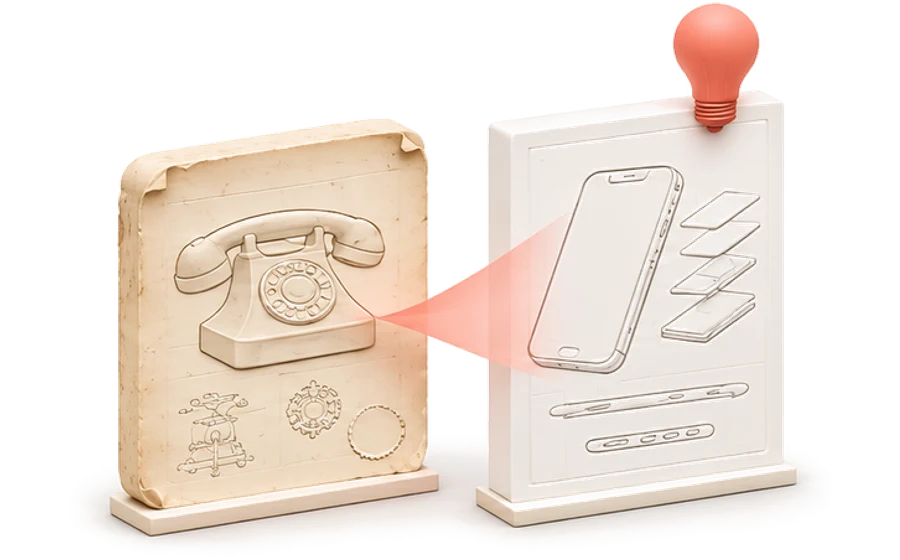
Cuando una patente nueva menciona otra anterior como referencia. Más citas = más influencia.
Measurement · 2025
Las 19 solicitudes de patente (aún no concedidas) que más han servido de referencia para los nuevos inventos del área.
Las solicitudes publicadas siguen en examen: pueden aprobarse, modificarse o rechazarse, pero ya influyen en nuevos inventos.
Cuando una patente nueva menciona otra anterior como referencia. Más citas = más influencia.
El evaluador de la Oficina de Patentes de EE. UU. Cita lo que se parece demasiado a la solicitud.
demasiado parecidaLa empresa o el inventor que pide la patente. Cita lo que le sirvió de inspiración.
fuente de inspiraciónLos inventos que la Oficina más usó como comparación: los más parecidos a lo que se patenta hoy.
Destacados
Osram GmbH 2020
17 inventores: Ricardo Ferreira, Stefan Hadrath y 15 másThe present disclosure relates to various embodiments of an optical component for a LIDAR Sensor System. The optical component may include an optical element having a first main surface and a second main surface opposite to the first main surface, a first lens array formed on the first main surface, and/or a second lens array formed on the second main surface. The optical element has a curved shape in a first direction of the LIDAR Sensor System.
17citas
Nvidia Corp 2019
15 inventores: Michael Alan Ditty y 14 más16citas
Innoviz Technologies Ltd 2018
11 inventores: Amit Steinberg y 10 másClasificación completa
Cada número indica cuántas veces la patente sirvió de referencia para nuevas patentes concedidas en EE. UU. en 2025. Toca cualquiera para ver el dibujo, quién la inventó y de qué trata.
Osram GmbH2020
31citas
Líder de la listaDe qué trata · original en inglés
The present disclosure relates to various embodiments of an optical component for a LIDAR Sensor System. The optical component may include an optical element having a first main surface and a second main surface opposite to the first main surface, a first lens array formed on the first main surface, and/or a second lens array formed on the second main surface. The optical element has a curved shape in a first direction of the LIDAR Sensor System.
Nvidia Corp2019
17citas
55 % del 1.º (31)De qué trata · original en inglés
Autonomous driving is one of the world's most challenging computational problems. Very large amounts of data from cameras, RADARs, LIDARs, and HD-Maps must be processed to generate commands to control the car safely and comfortably in real-time. This challenging task requires a dedicated supercomputer that is energy-efficient and low-power, complex high-performance software, and breakthroughs in deep learning AI algorithms. To meet this task, the present technology provides advanced systems and methods that facilitate autonomous driving functionality, including a platform for autonomous driving Levels 3, 4, and/or 5. In preferred embodiments, the technology provides an end-to-end platform with a flexible architecture, including an architecture for autonomous vehicles that leverages computer vision and known ADAS techniques, providing diversity and redundancy, and meeting functional safety standards. The technology provides for a faster, more reliable, safer, energy-efficient and space-efficient System-on-a-Chip, which may be integrated into a flexible, expandable platform that enables a wide-range of autonomous vehicles, including cars, taxis, trucks, and buses, as well as watercraft and aircraft.
Innoviz Technologies Ltd2018
16citas
52 % del 1.º (31)De qué trata · original en inglés
A LIDAR system is provided. The LIDAR system comprises at least one processor configured to: control at least one light source in a manner enabling light intensity to vary over a scan of a field of view using light from the at least one light source; control at least one light deflector to deflect light from the at least one light source; obtain an identification of at least one distinct region of interest in the field of view; and increase light allocation to the at least one distinct region of interest relative to other regions, such that following a first scanning cycle, light intensity in at least one subsequent second scanning cycle at locations associated with the at least one distinct region of interest is higher than light intensity in the first scanning cycle at the locations associated with the at least one distinct region of interest.
Nvidia Corp2021
16citas
52 % del 1.º (31)De qué trata · original en inglés
An end-to-end system for data generation, map creation using the generated data, and localization to the created map is disclosed. Mapstreams—or streams of sensor data, perception outputs from deep neural networks (DNNs), and/or relative trajectory data—corresponding to any number of drives by any number of vehicles may be generated and uploaded to the cloud. The mapstreams may be used to generate map data—and ultimately a fused high definition (HD) map—that represents data generated over a plurality of drives. When localizing to the fused HD map, individual localization results may be generated based on comparisons of real-time data from a sensor modality to map data corresponding to the same sensor modality. This process may be repeated for any number of sensor modalities and the results may be fused together to determine a final fused localization result.
Nvidia Corp2021
16citas
52 % del 1.º (31)De qué trata · original en inglés
A deep neural network(s) (DNN) may be used to detect objects from sensor data of a three dimensional (3D) environment. For example, a multi-view perception DNN may include multiple constituent DNNs or stages chained together that sequentially process different views of the 3D environment. An example DNN may include a first stage that performs class segmentation in a first view (e.g., perspective view) and a second stage that performs class segmentation and/or regresses instance geometry in a second view (e.g., top-down). The DNN outputs may be processed to generate 2D and/or 3D bounding boxes and class labels for detected objects in the 3D environment. As such, the techniques described herein may be used to detect and classify animate objects and/or parts of an environment, and these detections and classifications may be provided to an autonomous vehicle drive stack to enable safe planning and control of the autonomous vehicle.
Ai Inc2022
15citas
48 % del 1.º (31)De qué trata · original en inglés
Provided is a method for operating a robot, including: capturing images of a workspace; capturing movement data indicative of movement of the robot; capturing LIDAR data as the robot performs work within the workspace; comparing at least one object from the captured images to objects in an object dictionary; identifying a class to which the at least one object belongs; generating a first iteration of a map of the workspace based on the LIDAR data; generating additional iterations of the map based on newly captured LIDAR data and newly captured movement data; actuating the robot to drive along a trajectory that follows along a planned path by providing pulses to one or more electric motors of wheels of the robot; and localizing the robot within an iteration of the map by estimating a position of the robot based on the movement data, slippage, and sensor errors.
Intel Corp2022
15citas
48 % del 1.º (31)De qué trata · original en inglés
According to various embodiments, a radar device is described comprising a processor configured to generate a scene comprising an object based on a plurality of receive wireless signals, generate a ground truth object parameter of the object and generate a dataset representative of the scene and a radar detector configured to determine an object parameter of the object using a machine learning algorithm and the dataset, determine an error value of the machine learning algorithm using a cost function, the object parameter, and the ground truth object parameter and adjust the machine learning algorithm values to reduce the error value.
Mobileye Vision Technologies Ltd2017
14citas
45 % del 1.º (31)De qué trata · original en inglés
Systems and methods are provided for self-aware adaptive navigation. In one implementation, a navigation system for a vehicle may include at least one processor. The at least one processor may be programmed to determine a navigational maneuver for the vehicle based, at least in part, on a comparison of a motion of the vehicle with respect to a predetermined model representative of a road segment. The at least one processor may be further programmed to receive, from a camera, at least one image representative of an environment of the vehicle. The at least one processor may be further programmed to determine, based on analysis of the at least one image, an existence in the environment of the vehicle of an navigational adjustment condition, cause the vehicle to adjust the navigational maneuver based on the existence of the navigational adjustment condition, and store information relating to the navigational adjustment condition.
Rydberg Technologies Inc2019
13citas
42 % del 1.º (31)De qué trata · original en inglés
Methods and apparatus for sensing or measuring an electromagnetic field. The method entails excitation into a distribution of Rydberg states of atoms of a gas occupying a test volume coextensive with the electromagnetic field. Transmission along a path traversing the test volume of at least one probe beam of electromagnetic radiation is measured at one or more frequencies overlapping a spectral feature, and a physical characteristic of the electromagnetic field is derived on the basis of variation of the spectral feature. In various embodiments, the electromagnetic field may be place in interferometric relation with another electromagnetic field. Time-varying electric field amplitude, frequency, phase and noise spectral distribution may be measured, and thus AM and FM modulated fields, as well as magnetic fields of about 1 Tesla. The apparatus for measuring the electromagnetic field may be unilaterally coupled to a probe field and detector or array of detectors.
Waymo LLC2019
13citas
42 % del 1.º (31)De qué trata · original en inglés
The technology relates to autonomous vehicles for transporting cargo and/or people between locations. Distributed sensor arrangements may not be suitable for vehicles such as large trucks, busses or construction vehicles. Side view mirror assemblies are provided that include a sensor suite of different types of sensors, including LIDAR, radar, cameras, etc. Each side assembly is rigidly secured to the vehicle by a mounting element. The sensors within the assembly may be aligned or arranged relative to a common axis or physical point of the housing. This enables self-referenced calibration of all sensors in the housing. Vehicle-level calibration can also be performed between the sensors on the left and right sides of the vehicle. Each side view mirror assembly may include a conduit that provides one or more of power, data and cooling to the sensors in the housing.
Los inventos que las propias empresas señalaron como base de su trabajo: las referencias del mercado.
Destacados
Strong Force IoT Portfolio 2016 LLC 2018
4 inventores: Charles Howard Cella, Gerald William Duffy, Jr. y 2 másIn embodiments of the present invention improved capabilities are described for a monitoring system for data collection in an industrial drilling environment comprising a data collector communicatively coupled to a plurality of input channels, wherein a subset of the plurality of input channels are communicatively coupled to sensors measuring operational parameters from an industrial drilling component; a data storage structured to store a plurality of collector routes and collected data that correspond to the plurality of input channels, wherein the plurality of collector routes each comprise a different data collection routine; a data acquisition circuit structured to interpret a plurality of detection values from the collected data, each of the plurality of detection values corresponding to at least one of the plurality of input channels; a data analysis circuit structured to analyze the collected data from the plurality of input channels to detect an anomalous condition associated with the industrial drilling component; and a data response circuit structured to switch one of the data collection routines from a first data collection routine to a second collection routine based on the detection of the anomalous condition.
48citas
Nvidia Corp 2019
15 inventores: Michael Alan Ditty y 14 más37citas
Nvidia Corp 2021
10 inventores: Nikolai Smolyanskiy y 9 másClasificación completa
Cada número indica cuántas veces la patente sirvió de referencia para nuevas patentes concedidas en EE. UU. en 2025. Toca cualquiera para ver el dibujo, quién la inventó y de qué trata.
Strong Force IoT Portfolio 2016 LLC2018
49citas
Líder de la listaDe qué trata · original en inglés
In embodiments of the present invention improved capabilities are described for a monitoring system for data collection in an industrial drilling environment comprising a data collector communicatively coupled to a plurality of input channels, wherein a subset of the plurality of input channels are communicatively coupled to sensors measuring operational parameters from an industrial drilling component; a data storage structured to store a plurality of collector routes and collected data that correspond to the plurality of input channels, wherein the plurality of collector routes each comprise a different data collection routine; a data acquisition circuit structured to interpret a plurality of detection values from the collected data, each of the plurality of detection values corresponding to at least one of the plurality of input channels; a data analysis circuit structured to analyze the collected data from the plurality of input channels to detect an anomalous condition associated with the industrial drilling component; and a data response circuit structured to switch one of the data collection routines from a first data collection routine to a second collection routine based on the detection of the anomalous condition.
Nvidia Corp2019
48citas
98 % del 1.º (49)De qué trata · original en inglés
Autonomous driving is one of the world's most challenging computational problems. Very large amounts of data from cameras, RADARs, LIDARs, and HD-Maps must be processed to generate commands to control the car safely and comfortably in real-time. This challenging task requires a dedicated supercomputer that is energy-efficient and low-power, complex high-performance software, and breakthroughs in deep learning AI algorithms. To meet this task, the present technology provides advanced systems and methods that facilitate autonomous driving functionality, including a platform for autonomous driving Levels 3, 4, and/or 5. In preferred embodiments, the technology provides an end-to-end platform with a flexible architecture, including an architecture for autonomous vehicles that leverages computer vision and known ADAS techniques, providing diversity and redundancy, and meeting functional safety standards. The technology provides for a faster, more reliable, safer, energy-efficient and space-efficient System-on-a-Chip, which may be integrated into a flexible, expandable platform that enables a wide-range of autonomous vehicles, including cars, taxis, trucks, and buses, as well as watercraft and aircraft.
Nvidia Corp2021
37citas
76 % del 1.º (49)De qué trata · original en inglés
A deep neural network(s) (DNN) may be used to detect objects from sensor data of a three dimensional (3D) environment. For example, a multi-view perception DNN may include multiple constituent DNNs or stages chained together that sequentially process different views of the 3D environment. An example DNN may include a first stage that performs class segmentation in a first view (e.g., perspective view) and a second stage that performs class segmentation and/or regresses instance geometry in a second view (e.g., top-down). The DNN outputs may be processed to generate 2D and/or 3D bounding boxes and class labels for detected objects in the 3D environment. As such, the techniques described herein may be used to detect and classify animate objects and/or parts of an environment, and these detections and classifications may be provided to an autonomous vehicle drive stack to enable safe planning and control of the autonomous vehicle.
Mitsubishi Electric Research Laboratories Inc2023
37citas
76 % del 1.º (49)De qué trata · original en inglés
The present disclosure provides a system and a method for motion prediction for autonomous driving. The system disclosed herein provides an efficient deep-neural-network-based system to jointly perform perception and motion prediction from 3D point clouds. This system is able to take a pair of LiDAR sweeps as input and outputs for each point in the second sweep, both a classification of the point into one of a set of semantic classes, and a motion vector indicating the motion of the point within the world coordinate system. The system includes a spatiotemporal pyramid network, which extracts deep spatial and temporal features in a hierarchical fashion. The training of this system is regularized with spatial and temporal consistency losses. Thus providing an improved motion planner for autonomous driving applications.
Google LLC2024
37citas
76 % del 1.º (49)De qué trata · original en inglés
Generally, the disclosure is directed to generalized objected location, where the located object is in accordance to a natural language (NL) query. More specifically, the embodiments include a unified generalized visual localization architecture. The architecture achieves enhanced performance on the following three tasks: referring expression comprehension, object localization, and object detection. The embodiments employ machine-learned NL models and/or image models. The architecture is enabled to understand and answer natural localization questions towards an image, to output multiple boxes, provide no output if the object is not present (e.g., a null result), as well as, solve general detection tasks.
Nvidia Corp2024
37citas
76 % del 1.º (49)De qué trata · original en inglés
In various examples, temporal-based perception for autonomous or semi-autonomous systems and applications is described. Systems and methods are disclosed that use a machine learning model (MLM) to intrinsically fuse feature maps associated with different sensors and different instances in time. To generate a feature map, image data generated using image sensors (e.g., cameras) located around a vehicle are processed using a MLM that is trained to generate the feature map. The MLM may then fuse the feature maps in order to generate a final feature map associated with a current instance in time. The feature maps associated with the previous instances in time may be preprocessed using one or more layers of the MLM, where the one or more layers are associated with performing temporal transformation before the fusion is performed. The MLM may then use the final feature map to generate one or more outputs.
Zhejiang University2024
37citas
76 % del 1.º (49)De qué trata · original en inglés
An RGB-T (Thermal) multispectral pedestrian detection method based on a target aware fusion strategy, which aims to accurately determine the position of pedestrians from a pair of RGB and thermal infrared images. Given a pair of RGB and thermal infrared image to be detected, this method firstly extracts multispectral features from the RGB and thermal infrared images; then the extracted multispectral features are fused by using a target aware fusion strategy; finally, the fused features are sent to a detection head for pedestrian detection, and the pedestrian position box and confidence are output. The method can effectively fuse the deep features of multispectral images, enhance the feature expression of pedestrian areas and suppress irrelevant background noise features during the fusion process, and can realize accurate pedestrian detection.
United States Department of the Air Force2024
37citas
76 % del 1.º (49)De qué trata · original en inglés
A method of topological data analysis feature engineering for data fusion and autonomy is provided. The method comprises providing a Topological Data Analysis AI/ML Pipeline (TDAML) algorithm for multimodal sensor data fusion in autonomy applications system further comprising combining raw heterogeneous multimodal sensor data at the topological level; measuring, recording, and tracking linear representations of an underlying data set; providing a linear representation of the underlying data set which is compatible to existing deep learning (DL) model architectures for training in autonomy tasks; and accessing the entire degree of freedom (DOF) space of raw multimodal sensor data for mitigating sensor modality adversarial threats and environmental attenuation concerns in contested military and civilian (urban) environments.
Intel Corp2022
36citas
73 % del 1.º (49)De qué trata · original en inglés
Sensor data is received from a plurality of sensors, where the plurality of sensors includes a first set of sensors and a second set of sensors, and at least a portion of the plurality of sensors are coupled to a vehicle. Control of the vehicle is automated based on at least a portion of the sensor data generated by the first set of sensors. Passenger attributes of one or more passengers within the autonomous vehicles are determined from sensor data generated by the second set of sensors. Attributes of the vehicle are modified based on the passenger attributes and the sensor data generated by the first set of sensors.
NEC Corp2023
36citas
73 % del 1.º (49)De qué trata · original en inglés
Systems and methods for data fusion and analysis of vehicle sensor data, including receiving a multiple modality input data stream from a plurality of different types of vehicle sensors, determining latent features by extracting modality-specific features from the input data stream, and aligning a distribution of the latent features of different modalities by feature-level data fusion. Classification probabilities can be determined for the latent features using a fused modality scene classifier. A tree-organized neural network can be trained to determine path probabilities and issue driving pattern judgments, with the tree-organized neural network including a soft tree model and a hard decision leaf. One or more driving pattern judgments can be issued based on a probability of possible driving patterns derived from the modality-specific features.
Nvidia Corp2024
36citas
73 % del 1.º (49)De qué trata · original en inglés
Autonomous driving is one of the world's most challenging computational problems. Very large amounts of data from cameras, RADARs, LIDARs, and HD-Maps must be processed to generate commands to control the car safely and comfortably in real-time. This challenging task requires a dedicated supercomputer that is energy-efficient and low-power, complex high-performance software, and breakthroughs in deep learning AI algorithms. To meet this task, the present technology provides advanced systems and methods that facilitate autonomous driving functionality, including a platform for autonomous driving Levels 3, 4, and/or 5. In preferred embodiments, the technology provides an end-to-end platform with a flexible architecture, including an architecture for autonomous vehicles that leverages computer vision and known ADAS techniques, providing diversity and redundancy, and meeting functional safety standards. The technology provides for a faster, more reliable, safer, energy-efficient and space-efficient System-on-a-Chip, which may be integrated into a flexible, expandable platform that enables a wide-range of autonomous vehicles, including cars, taxis, trucks, and buses, as well as watercraft and aircraft.




 Tecnología informática
 Transporte

 Maquinaria eléctrica y energía
 Sistemas de control

 Tecnología médica

 Análisis de materiales biológicos
 Óptica