




Cita
Cuando una patente nueva menciona otra anterior como referencia. Más citas = más influencia.
Optics · 2025
Las 19 solicitudes de patente (aún no concedidas) que más han servido de referencia para los nuevos inventos del área.
Las solicitudes publicadas siguen en examen: pueden aprobarse, modificarse o rechazarse, pero ya influyen en nuevos inventos.
Cuando una patente nueva menciona otra anterior como referencia. Más citas = más influencia.
El evaluador de la Oficina de Patentes de EE. UU. Cita lo que se parece demasiado a la solicitud.
demasiado parecidaLa empresa o el inventor que pide la patente. Cita lo que le sirvió de inspiración.
fuente de inspiraciónLos inventos que la Oficina más usó como comparación: los más parecidos a lo que se patenta hoy.
Destacados
Osterhout Group Inc 2013
2 inventores: John N. Border y John D. HaddickA system and method for providing informational labels with perceived depth in the field of view of a user of a head mounted display device. In one embodiment, the method includes determining a physical location of the user and the head mounted display device, and identifying and determining a distance from the user to one or more objects of interest in the user's field of view. Using the distance from the user for each object, one can calculate a disparity value for viewing each object. The processor of the head mounted device may gather information concerning each of the objects in which the user is interested. The head mounted display device then provides a label for each of the objects and for each eye of the user, and, using the disparity values, places the labels within the field of view of the user.
13citas
Magic Leap Inc 2019
5 inventores: Asif Sinay y 4 más13citas
Waymo LLC 2019
2 inventores: William Grossman y 1 másClasificación completa
Cada número indica cuántas veces la patente sirvió de referencia para nuevas patentes concedidas en EE. UU. en 2025. Toca cualquiera para ver el dibujo, quién la inventó y de qué trata.
Osterhout Group Inc2013
15citas
Líder de la listaDe qué trata · original en inglés
A system and method for providing informational labels with perceived depth in the field of view of a user of a head mounted display device. In one embodiment, the method includes determining a physical location of the user and the head mounted display device, and identifying and determining a distance from the user to one or more objects of interest in the user's field of view. Using the distance from the user for each object, one can calculate a disparity value for viewing each object. The processor of the head mounted device may gather information concerning each of the objects in which the user is interested. The head mounted display device then provides a label for each of the objects and for each eye of the user, and, using the disparity values, places the labels within the field of view of the user.
Magic Leap Inc2019
13citas
87 % del 1.º (15)De qué trata · original en inglés
A head mounted display system can include a camera, at least one waveguide, at least one coupling optical element that is configured such that light is coupled into said waveguide and guided therein, and at least one out-coupling element. The at least one out-coupling element can be configured to couple light that is guided within said waveguide out of said waveguide and direct said light to said camera. The camera can be disposed in an optical path with respect to said at least one out-coupling optical element to receive at least a portion of the light that is coupled into said waveguide via the coupling element and guided therein and that is coupled out from said waveguide by said out-coupling coupling element such that images may be captured by said camera.
Waymo LLC2019
13citas
87 % del 1.º (15)De qué trata · original en inglés
The technology relates to autonomous vehicles for transporting cargo and/or people between locations. Distributed sensor arrangements may not be suitable for vehicles such as large trucks, busses or construction vehicles. Side view mirror assemblies are provided that include a sensor suite of different types of sensors, including LIDAR, radar, cameras, etc. Each side assembly is rigidly secured to the vehicle by a mounting element. The sensors within the assembly may be aligned or arranged relative to a common axis or physical point of the housing. This enables self-referenced calibration of all sensors in the housing. Vehicle-level calibration can also be performed between the sensors on the left and right sides of the vehicle. Each side view mirror assembly may include a conduit that provides one or more of power, data and cooling to the sensors in the housing.
Inventores independientes2010
12citas
80 % del 1.º (15)De qué trata · original en inglés
A near-to-eye display system for forming an image as an illuminated region on a retina of at least one eye of a user is disclosed. The system includes a source of modulated light, a proximal optic positionable adjacent an eye of the user to receive the modulated light. The proximal optic has a plurality of groups of optically redirecting regions. The optically redirecting regions are configured to direct a plurality of beams of the modulated light into a pupil of the eye to form a contiguous illuminated portion of the retina of the eye. A first group of the optically redirecting regions is configured to receive modulated light from the source and redirect beams of the modulated light into the pupil of the eye for illumination of a first portion of the retina. A second group of the optically redirecting regions is configured to receive modulated light from the source and redirect beams of the modulated light into the pupil of the eye for illumination of a second portion of the retina.
Osterhout Group Inc2013
12citas
80 % del 1.º (15)De qué trata · original en inglés
This disclosure concerns a near field communication (NFC) device which includes a wrist-worn NFC-enabled electronics device, wherein the wrist-worn NFC enabled electronics device includes a first communications link for communicating with a second NFC-enabled electronics device via NFC protocols, and a second communications link for communicating with an eyepiece via a medium-range communications protocol and receiving control commands. The wrist-worn NFC-enabled electronics device facilitates the transfer of data between the eyepiece and the second NFC-enabled electronics device. The eyepiece comprises optics enabling a see-through display on which is displayed the data.
Magic Leap Inc2015
10citas
67 % del 1.º (15)De qué trata · original en inglés
A waveguide apparatus includes a planar waveguide and at least one optical diffraction element (DOE) that provides a plurality of optical paths between an exterior and interior of the planar waveguide. A phase profile of the DOE may combine a linear diffraction grating with a circular lens, to shape a wave front and produce beams with desired focus. Waveguide apparati may be assembled to create multiple focal planes. The DOE may have a low diffraction efficiency, and planar waveguides may be transparent when viewed normally, allowing passage of light from an ambient environment (e.g., real world) useful in AR systems. Light may be returned for temporally sequentially passes through the planar waveguide. The DOE(s) may be fixed or may have dynamically adjustable characteristics. An optical coupler system may couple images to the waveguide apparatus from a projector, for instance a biaxially scanning cantilevered optical fiber tip.
Magic Leap Inc2016
10citas
67 % del 1.º (15)De qué trata · original en inglés
Configurations are disclosed for presenting virtual reality and augmented reality experiences to users. The system may comprise an image capturing device to capture one or more images, the one or more images corresponding to a field of the view of a user of a head-mounted augmented reality device, and a processor communicatively coupled to the image capturing device to extract a set of map points from the set of images, to identify a set of sparse points and a set of dense points from the extracted set of map points, and to perform a normalization on the set of map points.
Magna Electronics Inc2016
10citas
67 % del 1.º (15)De qué trata · original en inglés
A vision system for a vehicle includes a plurality of cameras having respective fields of view exterior of the vehicle. The plurality of cameras includes driver and passenger side wide angle cameras having wide angle fields of view, driver and passenger side rearward viewing cameras having fields of view along the respective sides of the vehicle rearward of the vehicle, and a rearward camera having a wide angle field of view rearward of the vehicle. A display is operable to display images derived from image data captured by at least some of the cameras. The display is selectively operable to display images derived from image data captured by all of the plurality of cameras. An image processor is operable to process image data captured by at least some of the cameras to detect objects in the field of view of the at least some of the cameras.
Samsung Electro Mechanics Co Ltd2018
10citas
67 % del 1.º (15)De qué trata · original en inglés
A camera module includes a housing having an internal space, a reflecting module including a reflecting member on a movable holder movably supported by an inner wall of the housing in the internal space, and a lens module disposed behind the reflecting module in the internal space, and including lenses aligned in an optical axis direction so that light reflected by the reflecting member is incident thereto. The movable holder is configured to move the reflecting member in a first axis direction approximately perpendicular to the optical axis direction and a second axis direction approximately perpendicular to the optical axis direction and the first axis direction with respect to the housing. The lens module includes at least two lens barrels disposed on sidewalls of the housing, linearly movable in approximately the optical axis direction, and including the lenses divided and disposed therein.
Holovisions LLC2019
10citas
67 % del 1.º (15)De qué trata · original en inglés
This invention is augmented reality eyewear with Volumetric Annular Photon Emission (VAPE) technology comprising: an annular light projector; an annular light reflector/refractor which redirects light rays from the annular light projector away from the person's eye; and a semi-reflective eyewear lens which reflects light rays from the projector back toward the person's eye and also transmits light rays from the environment toward the person's eye. This technology can enable a person to see their environment with minimal vision impairment while simultaneously displaying virtual objects with minimal light loss.
Inventores independientes2020
10citas
67 % del 1.º (15)De qué trata · original en inglés
An interactive mixed reality system for one or more users, in which both real-world entities and virtual world entities are capable of being interacted with by one or more users, or by objects (47, 91) for use by users, and the system arranged to computationally maintain game state and the evolution of events in the real-world and the virtual world, and the system arranged to generate a response (such as visual or tactile/haptic, or by way of cause and effect) which is experienced or perceived by the one or more users.
Los inventos que las propias empresas señalaron como base de su trabajo: las referencias del mercado.
Destacados
Magic Leap Inc 2016
3 inventores: Gary Bradski, Samuel A. Miller y 1 másConfigurations are disclosed for presenting virtual reality and augmented reality experiences to users. The system may comprise an image capturing device to capture one or more images, the one or more images corresponding to a field of the view of a user of a head-mounted augmented reality device, and a processor communicatively coupled to the image capturing device to extract a set of map points from the set of images, to identify a set of sparse points and a set of dense points from the extracted set of map points, and to perform a normalization on the set of map points.
143citas
Magic Leap Inc 2015
3 inventores: Rony Abovitz y 2 más134citas
Augmented Vision Inc 2014
3 inventores: Chunyu Gao y 2 másClasificación completa
Cada número indica cuántas veces la patente sirvió de referencia para nuevas patentes concedidas en EE. UU. en 2025. Toca cualquiera para ver el dibujo, quién la inventó y de qué trata.
Magic Leap Inc2016
144citas
Líder de la listaDe qué trata · original en inglés
Configurations are disclosed for presenting virtual reality and augmented reality experiences to users. The system may comprise an image capturing device to capture one or more images, the one or more images corresponding to a field of the view of a user of a head-mounted augmented reality device, and a processor communicatively coupled to the image capturing device to extract a set of map points from the set of images, to identify a set of sparse points and a set of dense points from the extracted set of map points, and to perform a normalization on the set of map points.
Magic Leap Inc2015
143citas
99 % del 1.º (144)De qué trata · original en inglés
A waveguide apparatus includes a planar waveguide and at least one optical diffraction element (DOE) that provides a plurality of optical paths between an exterior and interior of the planar waveguide. A phase profile of the DOE may combine a linear diffraction grating with a circular lens, to shape a wave front and produce beams with desired focus. Waveguide apparati may be assembled to create multiple focal planes. The DOE may have a low diffraction efficiency, and planar waveguides may be transparent when viewed normally, allowing passage of light from an ambient environment (e.g., real world) useful in AR systems. Light may be returned for temporally sequentially passes through the planar waveguide. The DOE(s) may be fixed or may have dynamically adjustable characteristics. An optical coupler system may couple images to the waveguide apparatus from a projector, for instance a biaxially scanning cantilevered optical fiber tip.
Augmented Vision Inc2014
134citas
93 % del 1.º (144)De qué trata · original en inglés
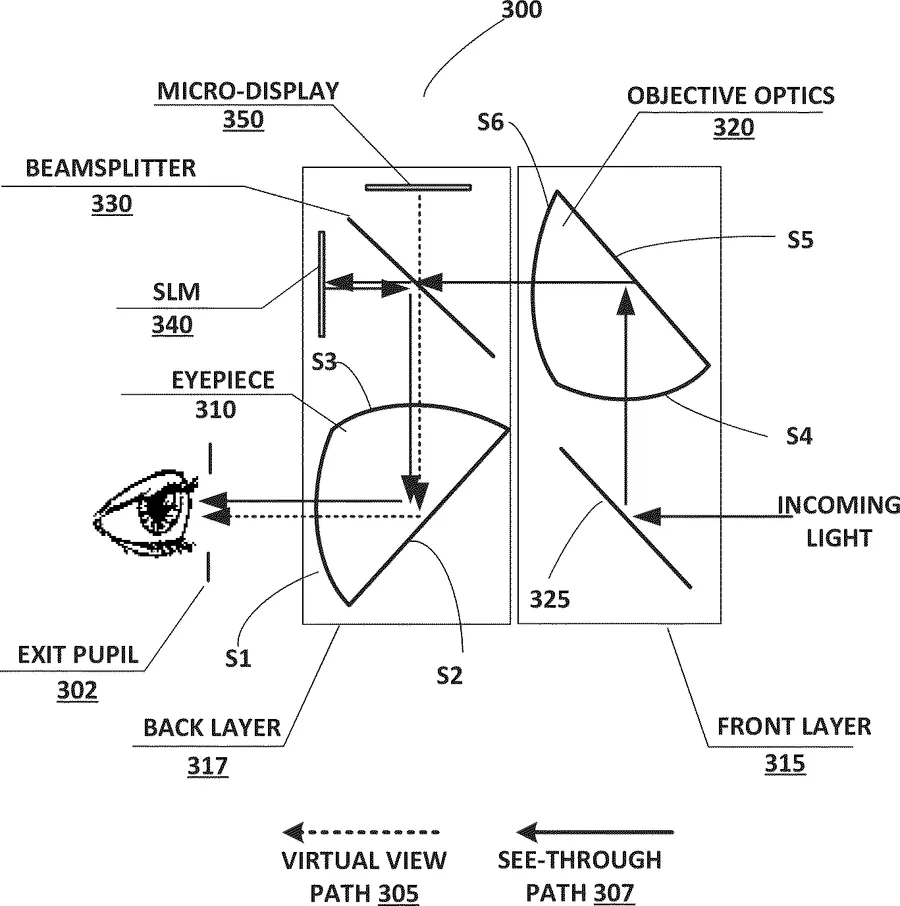
The present invention comprises a compact optical see-through head-mounted display capable of combining, a see-through image path with a virtual image path such that the opaqueness of the see-through image path can be modulated and the virtual image occludes parts of the see-through image and vice versa.
Magic Leap Inc2015
127citas
88 % del 1.º (144)De qué trata · original en inglés
Configurations are disclosed for presenting virtual reality and augmented reality experiences to users. The system may comprise an image-generating source to provide one or more frames of image data in a time-sequential manner, a light modulator configured to transmit light associated with the one or more frames of image data, a substrate to direct image information to a user's eye, wherein the substrate houses a plurality of reflectors, a first reflector of the plurality of reflectors to reflect transmitted light associated with a first frame of image data at a first angle to the user's eye, and a second reflector to reflect transmitted light associated with a second frame of the image data at a second angle to the user's eye.
Inventores independientes2012
124citas
86 % del 1.º (144)De qué trata · original en inglés
An augmented reality system provides improved focus of real and virtual objects. A see-through display device includes a variable focus lens a user looks through. A focal region adjustment unit automatically focuses the variable focus lens in a current user focal region. A microdisplay assembly attached to the see-through display device generates a virtual object for display in the user's current focal region by adjusting its focal region. The variable focus lens may also be adjusted to provide one or more zoom features. Visual enhancement of an object may also be provided to improve a user's perception of an object.
Inventores independientes2013
123citas
85 % del 1.º (144)De qué trata · original en inglés
One embodiment is directed to a system for enabling two or more users to interact within a virtual world comprising virtual world data, comprising a computer network comprising one or more computing devices, the one or more computing devices comprising memory, processing circuitry, and software stored at least in part in the memory and executable by the processing circuitry to process at least a portion of the virtual world data; wherein at least a first portion of the virtual world data originates from a first user virtual world local to a first user, and wherein the computer network is operable to transmit the first portion to a user device for presentation to a second user, such that the second user may experience the first portion from the location of the second user, such that aspects of the first user virtual world are effectively passed to the second user.
Magic Leap Inc2015
115citas
80 % del 1.º (144)De qué trata · original en inglés
Configurations are disclosed for presenting virtual reality and augmented reality experiences to users. The system may comprise a spatial light modulator operatively coupled to an image source for projecting light associated with one or more frames of image data, and a variable focus element (VFE) for varying a focus of the projected light such that a first frame of image data is focused at a first depth plane, and a second frame of image data is focused at a second depth plane, and wherein a distance between the first depth plane and the second depth plane is fixed.
Magic Leap Inc2014
114citas
79 % del 1.º (144)De qué trata · original en inglés
Optical systems such as image display systems include a freeform optical waveguide prism and a freeform compensation lens spaced therefrom by a gap of air or index cement. The compensation lens corrects for aberrations which the optical waveguide prism will introduce in light or images from an ambient real-world environment. The optical waveguide prism receives actively projected images at an entry location, and emits the projected images at an exit location after internally reflecting the images along an optical path therein. The image display system may include an image source and coupling optics. The approach permits design of an optical viewing device, for example in optical see-through HMDs, achieving an eyeglass-form appearance and a wide see-through field of view (FOV).
Inventores independientes2012
110citas
76 % del 1.º (144)De qué trata · original en inglés
This invention concerns an ergonomic optical see-through head mounted display device with an eyeglass appearance. The see-through head-mounted display device consists of a transparent, freeform waveguide prism for viewing a displayed virtual image, a see-through compensation lens for enabling proper viewing of a real-world scene when combined together with the prism, and a miniature image display unit for supplying display content. The freeform waveguide prism, containing multiple freeform refractive and reflective surfaces, guides light originated from the miniature display unit toward a user's pupil and enables a user to view a magnified image of the displayed content. A see-through compensation lens, containing multiple freeform refractive surfaces, enables proper viewing of the surrounding environment, through the combined waveguide and lens. The waveguide prism and the see-through compensation lens are properly designed to ergonomically fit human heads enabling a wraparound design of a lightweight, compact, and see-through display system.
Magic Leap Inc2014
110citas
76 % del 1.º (144)De qué trata · original en inglés
One embodiment is directed to a user display device comprising a housing frame mountable on the head of the user, a lens mountable on the housing frame and a projection sub system coupled to the housing frame to determine a location of appearance of a display object in a field of view of the user based at least in part on at least one of a detection of a head movement of the user and a prediction of a head movement of the user, and to project the display object to the user based on the determined location of appearance of the display object.





 Tecnología audiovisual
 Tecnología informática

 Semiconductores
 Medición

 Maquinaria eléctrica y energía

 Tecnología médica
 Telecomunicaciones