






Citation
When a new patent lists an older one as a reference. More citations = more influence.
WIPO technology field · 2025
The 20 patent applications (not yet granted) that served most often as references for new inventions in this field.
Published applications are still under review: they may be granted, amended or rejected — but they already influence new inventions.
When a new patent lists an older one as a reference. More citations = more influence.
The U.S. Patent Office reviewer. Cites what is too similar to the application.
too similarThe company or inventor filing the patent. Cites what inspired their work.
inspirationThe inventions the Patent Office used most for comparison — the closest to what is being patented today.
Highlights
Université Laval 2017
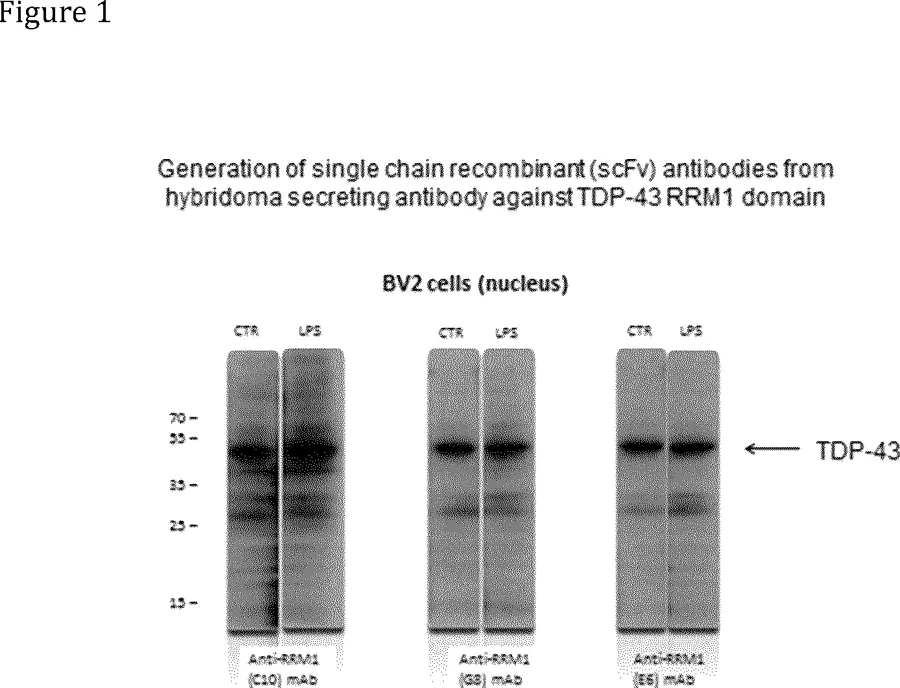
3 inventors: Jean-Pierre Julien, Claude Gravel and 1 moreProvided herein are antigen-binding constructs such as antibodies that bind to the RRM-1 domain of TDP-43. The antigen-binding constructs are capable of blocking the interaction of TDP-43 with NF-κB in cells. Also provided herein are method of using the antigen-binding constructs in the treatment of diseases associated with TPD-43 proteinopathy, such as amyotrophic lateral sclerosis (ALS), frontotemperal lobar degeneration (FTLD), Lewy body disease and motor neuron disease.
10citations
Massachusetts Institute of Technology 2016
5 inventors: Feng Zhang and 4 more7citations
Independent inventors 2004
Inventor: Hanan PolanskyFull ranking
Each number shows how many times the patent was used as a reference by new U.S. patents granted in 2025. Tap any of them to see the drawing, who invented it and what it does.
Université Laval2017
16citations
Top of the listWhat it does
Provided herein are antigen-binding constructs such as antibodies that bind to the RRM-1 domain of TDP-43. The antigen-binding constructs are capable of blocking the interaction of TDP-43 with NF-κB in cells. Also provided herein are method of using the antigen-binding constructs in the treatment of diseases associated with TPD-43 proteinopathy, such as amyotrophic lateral sclerosis (ALS), frontotemperal lobar degeneration (FTLD), Lewy body disease and motor neuron disease.
Massachusetts Institute of Technology2016
10citations
63% of 1st (16)What it does
The invention provides for systems, methods, and compositions for targeting nucleic acids. In particular, the invention provides non-naturally occurring or engineered DNA or RNA-targeting systems comprising a novel DNA or RNA-targeting CRISPR effector protein and at least one targeting nucleic acid component like a guide RNA.
Independent inventors2004
7citations
44% of 1st (16)What it does
A recent discovery showed that microcompetition between a foreign polynucleotide and a cellular polynucleotide is a risk factor for some of the major chronic diseases. The invention uses this novel discovery to present assays for screening compounds based on their effectiveness in modulating such microcompetition. The effective compounds can be used in treatment of these chronic diseases. The invention also presents assays for screening compounds that can be used in treatment of chronic diseases resulting from other foreign polynucleotide-type disruptions.
INQ BIOSCIENCES Corp2011
6citations
38% of 1st (16)What it does
Culture systems, devices and related methods and articles may automate the culturing or incubation process according to defined culturing protocols. Such may employ removable multi-well growth cassette. Wells may be subdivided into subwells. Such may employ removable media and waste cartridges and/or gas canisters to supply consumables, which may be supplied in kits, for example with processor executable culturing protocols. Direct fluidic coupling between growth cassettes and the removable cartridges or canisters may be employed. Operational and/or environmental conditions may be sensed or monitored, and may be used to adjust or alter operation. A microscopy subsystem may capture images which may be stored and/or analyzed. Analysis may be used to adjust or alter operation.
Urocor Inc2003
5citations
31% of 1st (16)What it does
Disclosed are diagnostic techniques for the detection of human prostate, bladder and breast cancer. Genetic probes and methods useful in monitoring the progression and diagnosis of prostate, bladder and breast cancer are described. The invention relates particularly to probes and methods for evaluating the presence of RNA species that are differentially expressed in prostate, bladder and breast cancer compared to normal human prostate, benign prostatic hyperplasia, or normal bladder or breast tissue.
Independent inventors2005
5citations
31% of 1st (16)What it does
The preparation and use of a transducing polypeptide (TP)— lipid vesicle complex having a small proportion of positively charged (cationic) lipids in the make-up of the lipid vesicle, e.g., liposome, for safe and efficient intracellular delivery of therapeutic agents, such as proteins, DNA, small molecules and/or other drugs, into a cell of a higher organism, in vitro or in vivo is disclosed. The delivery system of the invention results in increased efficacy of intracellular delivery of such agents, bypassing the endocytotic pathway of intracellular delivery while at the same time minimizing the toxicity of the delivery system towards the recipient cells.
Hermes Biosciences Inc2007
5citations
31% of 1st (16)What it does
The present invention provides liposome compositions containing substituted ammonium and/or polyanion, and optionally with a desired therapeutic or imaging entity. The present invention also provide methods of making the liposome compositions provided by the present invention.
Spatial Transcriptomics AB2014
5citations
31% of 1st (16)What it does
The present invention relates to methods and products for the localized or spatial detection of nucleic acid in a tissue sample and in particular to a method for localized detection of nucleic acid in a tissue sample comprising: (a) providing an array comprising a substrate on which multiple species of capture probes are directly or indirectly immobilized such that each species occupies a distinct position on the array and is oriented to have a free 3′ end to enable said probe to function as a primer for a primer extension or ligation reaction, wherein each species of said capture probe comprises a nucleic acid molecule with 5′ to 3′: (i) a positional domain that corresponds to the position of the capture probe on the array, and (ii) a capture domain; (b) contacting said array with a tissue sample such that the position of a capture probe on the array may be correlated with a position in the tissue sample and allowing nucleic acid of the tissue sample to hybridize to the capture domain in said capture probes; (c) generating DNA molecules from the captured nucleic acid molecules using said capture probes as extension or ligation primers, wherein said extended or ligated DNA molecules are tagged by virtue of the positional domain; (d) optionally generating a complementary strand of said tagged DNA and/or optionally amplifying said tagged DNA; (e) releasing at least part of the tagged DNA molecules and/or their complements or amplicons from the surface of the array, wherein said part includes the positional domain or a complement thereof; and (f) directly or indirectly analyzing the sequence of the released DNA molecules.
University of Vienna2014
5citations
31% of 1st (16)What it does
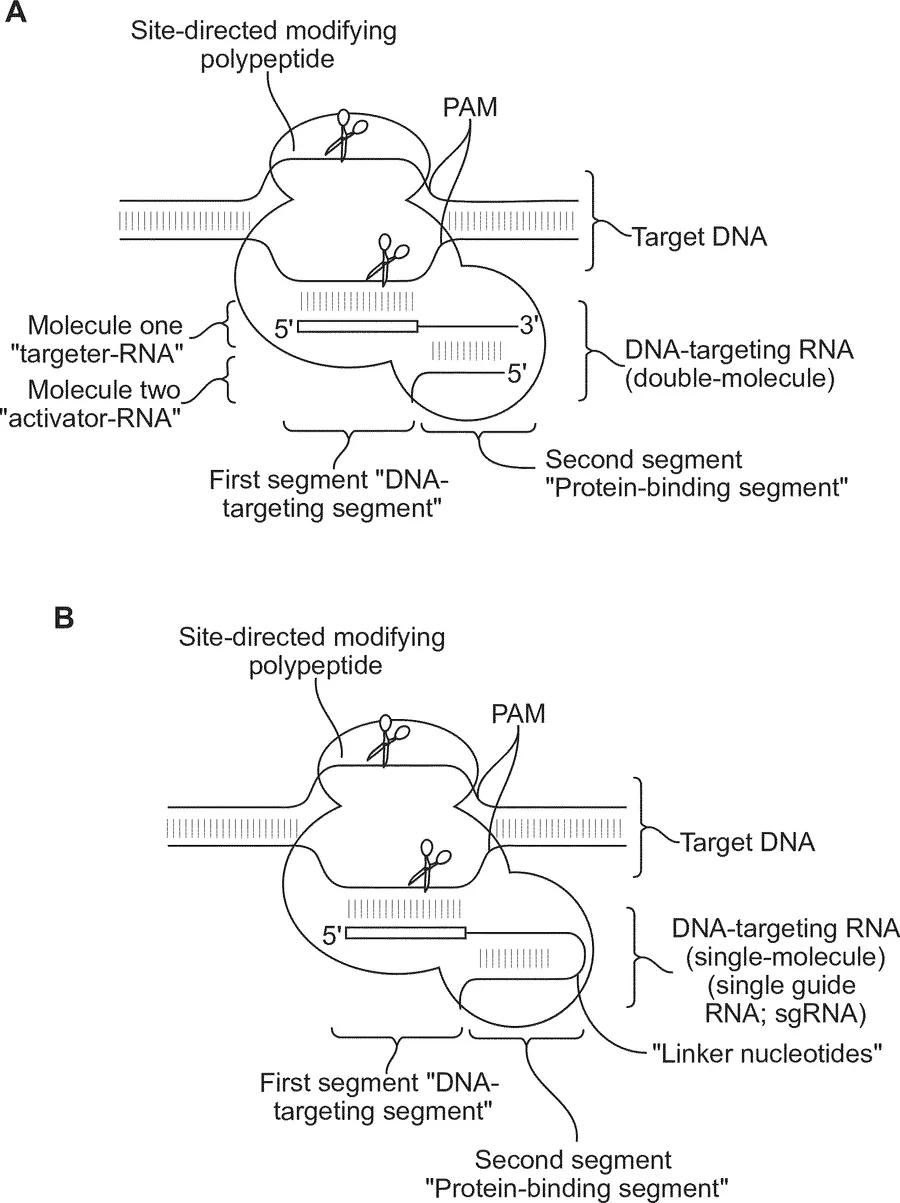
The present disclosure provides a DNA-targeting RNA that comprises a targeting sequence and, together with a modifying polypeptide, provides for site-specific modification of a target DNA and/or a polypeptide associated with the target DNA. The present disclosure further provides site-specific modifying polypeptides. The present disclosure further provides methods of site-specific modification of a target DNA and/or a polypeptide associated with the target DNA The present disclosure provides methods of modulating transcription of a target nucleic acid in a target cell, generally involving contacting the target nucleic acid with an enzymatically inactive Cas9 polypeptide and a DNA-targeting RNA. Kits and compositions for carrying out the methods are also provided. The present disclosure provides genetically modified cells that produce Cas9; and Cas9 transgenic non-human multicellular organisms.
Cellular Research Inc2015
5citations
31% of 1st (16)What it does
The disclosure provides for methods, compositions, and kits for multiplex nucleic acid analysis of single cells. The methods, compositions and systems may be used for massively parallel single cell sequencing. The methods, compositions and systems may be used to analyze thousands of cells concurrently. The thousands of cells may comprise a mixed population of cells (e.g., cells of different types or subtypes, different sizes).
Elstar Therapeutics Inc2017
5citations
31% of 1st (16)What it does
Multispecific molecules that include i) a tumor-targeting moiety; and one, two or all of: (ii) an immune cell engager (e.g., chosen from an NK cell engager, a T cell engager, a B cell engager, a dendritic cell engager, or a macrophage cell engager); (iii) a cytokine molecule; and/or (iv) a stromal modifying moiety are disclosed. Additionally disclosed are nucleic acids encoding the same, methods of producing the aforesaid molecules, and methods of treating a cancer using the aforesaid molecules.
The inventions companies themselves named as the foundation of their work — the market’s references.
Highlights
University of Vienna 2014
7 inventors: Jennifer A. Doudna, Martin Jinek and 5 moreThe present disclosure provides a DNA-targeting RNA that comprises a targeting sequence and, together with a modifying polypeptide, provides for site-specific modification of a target DNA and/or a polypeptide associated with the target DNA. The present disclosure further provides site-specific modifying polypeptides. The present disclosure further provides methods of site-specific modification of a target DNA and/or a polypeptide associated with the target DNA The present disclosure provides methods of modulating transcription of a target nucleic acid in a target cell, generally involving contacting the target nucleic acid with an enzymatically inactive Cas9 polypeptide and a DNA-targeting RNA. Kits and compositions for carrying out the methods are also provided. The present disclosure provides genetically modified cells that produce Cas9; and Cas9 transgenic non-human multicellular organisms.
92citations
Independent inventors 2007
6 inventors: Megan McCloskey and 5 more90citations
Ion Torrent Systems Inc 2009
2 inventors: Jonathan M. Rothberg and 1 moreFull ranking
Each number shows how many times the patent was used as a reference by new U.S. patents granted in 2025. Tap any of them to see the drawing, who invented it and what it does.
University of Vienna2014
110citations
Top of the listWhat it does
The present disclosure provides a DNA-targeting RNA that comprises a targeting sequence and, together with a modifying polypeptide, provides for site-specific modification of a target DNA and/or a polypeptide associated with the target DNA. The present disclosure further provides site-specific modifying polypeptides. The present disclosure further provides methods of site-specific modification of a target DNA and/or a polypeptide associated with the target DNA The present disclosure provides methods of modulating transcription of a target nucleic acid in a target cell, generally involving contacting the target nucleic acid with an enzymatically inactive Cas9 polypeptide and a DNA-targeting RNA. Kits and compositions for carrying out the methods are also provided. The present disclosure provides genetically modified cells that produce Cas9; and Cas9 transgenic non-human multicellular organisms.
Independent inventors2007
92citations
84% of 1st (110)What it does
In a first aspect, the present invention provides methods for authenticating a nucleic acid molecule and its sequence with a molecular barcode and batch-stamp. In another aspect, the present invention provides methods for authenticating a nucleic acid amplification product. In a further aspect, the present invention provides compositions for encoding both single-stranded and double-stranded target nucleic acids with coded oligonucleotides. The compositions are useful in the practice of the methods of the invention.
Ion Torrent Systems Inc2009
90citations
82% of 1st (110)What it does
Methods and apparatus relating to very large scale FET arrays for analyte measurements. ChemFET (e.g., ISFET) arrays may be fabricated using conventional CMOS processing techniques based on improved FET pixel and array designs that increase measurement sensitivity and accuracy, and at the same time facilitate significantly small pixel sizes and dense arrays. Improved array control techniques provide for rapid data acquisition from large and dense arrays. Such arrays may be employed to detect a presence and/or concentration changes of various analyte types in a wide variety of chemical and/or biological processes. In one example, chemFET arrays facilitate DNA sequencing techniques based on monitoring changes in hydrogen ion concentration (pH), changes in other analyte concentration, and/or binding events associated with chemical processes relating to DNA synthesis.
Independent inventors2007
80citations
73% of 1st (110)What it does
The invention provides methods and compositions for counting molecules in a sample, wherein each molecule is labeled with a unique oligonucleotide tag. Such tags are amplified and identified rather than the molecules themselves; that is, the problem of counting molecules is converted into the problem of counting tags. In one aspect of the invention, molecules to be counted are labeled by sampling. That is, conjugates are formed between the molecules to be counted and oligonucleotide tags of a very large set, or repertoire. After conjugation, a sample of conjugates is taken that is sufficiently small so that substantially every molecule has a unique oligonucleotide tag. Counting of different tags may be accomplished in a variety of ways. In one aspect, different tags may be counted by carrying out a series of sorting steps to generate successively less complex mixtures in which tags are enumerated using length-encoded “metric” tags. In another aspect, different tags may be counted by directly sequencing a sample of tags using any one of several different sequencing methodologies.
Ion Torrent Systems Inc2010
78citations
71% of 1st (110)What it does
Methods and apparatus relating to FET arrays including large FET arrays for monitoring chemical and/or biological reactions such as nucleic acid sequencing-by-synthesis reactions. Some methods provided herein relate to improving signal (and also signal to noise ratio) from released hydrogen ions during nucleic acid sequencing reactions.
Ion Torrent Systems Inc2009
77citations
70% of 1st (110)What it does
Methods and apparatus relating to very large scale FET arrays for analyte measurements. ChemFET (e.g., ISFET) arrays may be fabricated using conventional CMOS processing techniques based on improved FET pixel and array designs that increase measurement sensitivity and accuracy, and at the same time facilitate significantly small pixel sizes and dense arrays. Improved array control techniques provide for rapid data acquisition from large and dense arrays. Such arrays may be employed to detect a presence and/or concentration changes of various analyte types in a wide variety of chemical and/or biological processes. In one example, chemFET arrays facilitate DNA sequencing techniques based on monitoring changes in hydrogen ion concentration (pH), changes in other analyte concentration, and/or binding events associated with chemical processes relating to DNA synthesis.
Harvard University2009
70citations
64% of 1st (110)What it does
Compositions and methods for making a plurality of probes for analyzing a plurality of nucleic acid samples are provided. Compositions and methods for analyzing a plurality of nucleic acid samples to obtain sequence information in each nucleic acid sample are also provided.
Northwestern University2010
70citations
64% of 1st (110)What it does
The present invention provides methods, systems, and compositions for interfering with the function and/or presence of a target DNA sequence in a eukaryotic cell (e.g., located in vitro or in a subject) using crRNA and CRISPR-associated (cas) proteins or cas encoding nucleic acids. The present invention also relates to a method for interfering with horizontal gene transfer based on the use of clustered, regularly interspaced short palindromic repeat (CRISPR) sequences.
Massachusetts Institute of Technology2014
68citations
62% of 1st (110)What it does
The invention provides for delivery, engineering and optimization of systems, methods, and compositions for manipulation of sequences and/or activities of target sequences. Provided are delivery systems and tissues or organ which are targeted as sites for delivery. Also provided are vectors and vector systems some of which encode one or more components of a CRISPR complex, as well as methods for the design and use of such vectors. Also provided are methods of directing CRISPR complex formation in eukaryotic cells to ensure enhanced specificity for target recognition and avoidance of toxicity and to edit or modify a target site in a genomic locus of interest to alter or improve the status of a disease or a condition.
Independent inventors2009
66citations
60% of 1st (110)What it does
An embodiment of an identifier element for identifying an origin of a template nucleic acid molecule is described that comprises a nucleic acid element comprising a sequence composition that enables detection of an introduced error in sequence data generated from the nucleic acid element and correction of the introduced error, where the nucleic acid element is constructed to couple with the end of a template nucleic acid molecule and identifies an origin of the template nucleic acid molecule.




 Pharmaceuticals

 Analysis of biological materials

 Medical technology

 Organic fine chemistry

 Chemical engineering

 Measurement

 Food chemistry