


Citation
When a new patent lists an older one as a reference. More citations = more influence.
WIPO technology field · 2025
The 21 patent applications (not yet granted) that served most often as references for new inventions in this field.
Published applications are still under review: they may be granted, amended or rejected — but they already influence new inventions.
When a new patent lists an older one as a reference. More citations = more influence.
The U.S. Patent Office reviewer. Cites what is too similar to the application.
too similarThe company or inventor filing the patent. Cites what inspired their work.
inspirationThe inventions the Patent Office used most for comparison — the closest to what is being patented today.
Highlights
Independent inventors 2017
Inventor: Philipp LangDevices and methods for performing a surgical step or surgical procedure with visual guidance using an optical head mounted display are disclosed.
26citations
Independent inventors 2021
Inventor: Philipp Lang25citations
Mako Surgical Corp 2006
19 inventors: Arthur Quaid and 18 moreFull ranking
Each number shows how many times the patent was used as a reference by new U.S. patents granted in 2025. Tap any of them to see the drawing, who invented it and what it does.
Independent inventors2017
32citations
Top of the listWhat it does
Devices and methods for performing a surgical step or surgical procedure with visual guidance using an optical head mounted display are disclosed.
Independent inventors2021
26citations
81% of 1st (32)What it does
Aspects of the present disclosure relate to systems, devices and methods for performing a surgical step or surgical procedure with visual guidance using an optical head mounted display. Aspects of the present disclosure relate to systems, devices and methods for displaying, placing, fitting, sizing, selecting, aligning, moving a virtual implant on a physical anatomic structure of a patient and, optionally, modifying or changing the displaying, placing, fitting, sizing, selecting, aligning, moving, for example based on kinematic information.
Mako Surgical Corp2006
25citations
78% of 1st (32)What it does
A surgical apparatus includes a surgical device, configured to be manipulated by a user to perform a procedure on a patient, and a computer system. The computer system is programmed to implement control parameters for controlling the surgical device to provide at least one of haptic guidance to the user and a limit on user manipulation of the surgical device, based on a relationship between an anatomy of the patient and at least one of a position, an orientation, a velocity, and an acceleration of a portion of the surgical device, and to adjust the control parameters in response to movement of the anatomy during the procedure.
Independent inventors2021
25citations
78% of 1st (32)What it does
This document describes technology comprising of one or more wearable devices (i.e. attached or applied to limbs, body, head or other body extremities but also applicable to implanted or physiologically attachable systems). These systems have a means of enabling diagnostic or prognostic monitoring applicable to monitoring relevant parameters and corresponding analysis determination and characterisation applicable to the onset or detection of events or health conditions of interest. One application relates to sleep monitoring and associate EEG sensors.
Apple Inc2015
22citations
69% of 1st (32)What it does
A user controls an external electronic device with a finger-ring-mounted touchscreen that includes a computer processor, wireless transceiver, and rechargeable power source; the ring is worn on a first finger receives an input from a second finger, selects one of a plurality of touch events associated with the input, and wirelessly transmits a command associated with the touch event to the external electronic device.
Independent inventors2017
21citations
66% of 1st (32)What it does
There is disclosed a medical system comprising one or more sensors associated with one or more actuators. Various embodiments describe sensors and/or actuators, logic circuits, user interfaces, association schemes, communication schemes, security schemes, cryptographic schemes, medical management rules, social mechanisms, energy management schemes, time and/or space schemes, body analytes and/or biomarkers, blood glucose and/or interstitial glucose sensors, drug delivery devices, continuous glucose monitoring devices, as well as flash glucose monitoring devices. Methods, software and other hardware aspects are described.
Tempus Labs Inc2021
21citations
66% of 1st (32)What it does
A method and system for storing user application programs and micro-service programs, for each of multiple patients that have cancerous cells and receive treatment, includes obtaining clinical records data in original forms, storing it in a semi-structured first database, generating sequencing data for the patient's cancerous and normal cells using a next generation genomic sequencer, storing the sequencing data in the first database, shaping at least some of the first database data to generate system structured data optimized for searching and including clinical record data, storing the structured data in a second database, for each user application program, selecting an application-specific subset of data from the second database and storing it in a structure optimized for application program interfacing in a third database, wherein an orchestration manager operatively connected to one or more micro-service programs receives status messages and initiates a respective micro-service program when program prerequisites are satisfied.
Independent inventors2013
20citations
63% of 1st (32)What it does
An apparatus comprises a sensor configured to detect movement and generate movement data related to at least part of a detected movement; a messaging unit configured to create a message that is configured to include movement information based at least in part upon the movement data; a transmitter in data communication with the messaging unit and configured to transmit the message; and a housing configured to at least partially enclose at least one of the sensor, the messaging unit, and the transmitter, and including a finger grip configured to secure the housing to a human finger. Methods of using the apparatus are also provided.
Magic Leap Inc2016
20citations
63% of 1st (32)What it does
Configurations are disclosed for a health system to be used in various healthcare applications, e.g., for patient diagnostics, monitoring, and/or therapy. The health system may comprise a light generation module to transmit light or an image to a user, one or more sensors to detect a physiological parameter of the user's body, including their eyes, and processing circuitry to analyze an input received in response to the presented images to determine one or more health conditions or defects.
Independent inventors2016
19citations
59% of 1st (32)What it does
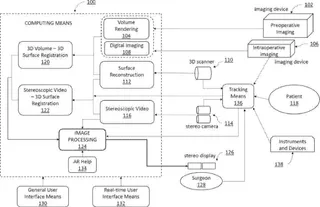
Embodiments disclose a real-time surgery method and apparatus for displaying a stereoscopic augmented view of a patient from a static or dynamic viewpoint of the surgeon, which employs real-time three-dimensional surface reconstruction for preoperative and intraoperative image registration. Stereoscopic cameras provide real-time images of the scene including the patient. A stereoscopic video display is used by the surgeon, who sees a graphical representation of the preoperative or intraoperative images blended with the video images in a stereoscopic manner through a see through display.
Tornier Inc2019
19citations
59% of 1st (32)What it does
An example method includes displaying, via a visualization device and overlaid on a portion of an anatomy of a patient viewable via the visualization device, a virtual model of the portion of the anatomy obtained from a virtual surgical plan for an orthopedic joint repair surgical procedure to attach a prosthetic to the anatomy; and displaying, via the visualization device and overlaid on the portion of the anatomy, a virtual guide that guides at least one of preparation of the anatomy for attachment of the prosthetic or attachment of the prosthetic to the anatomy.
The inventions companies themselves named as the foundation of their work — the market’s references.
Highlights
Ethicon Endo Surgery Inc 2014
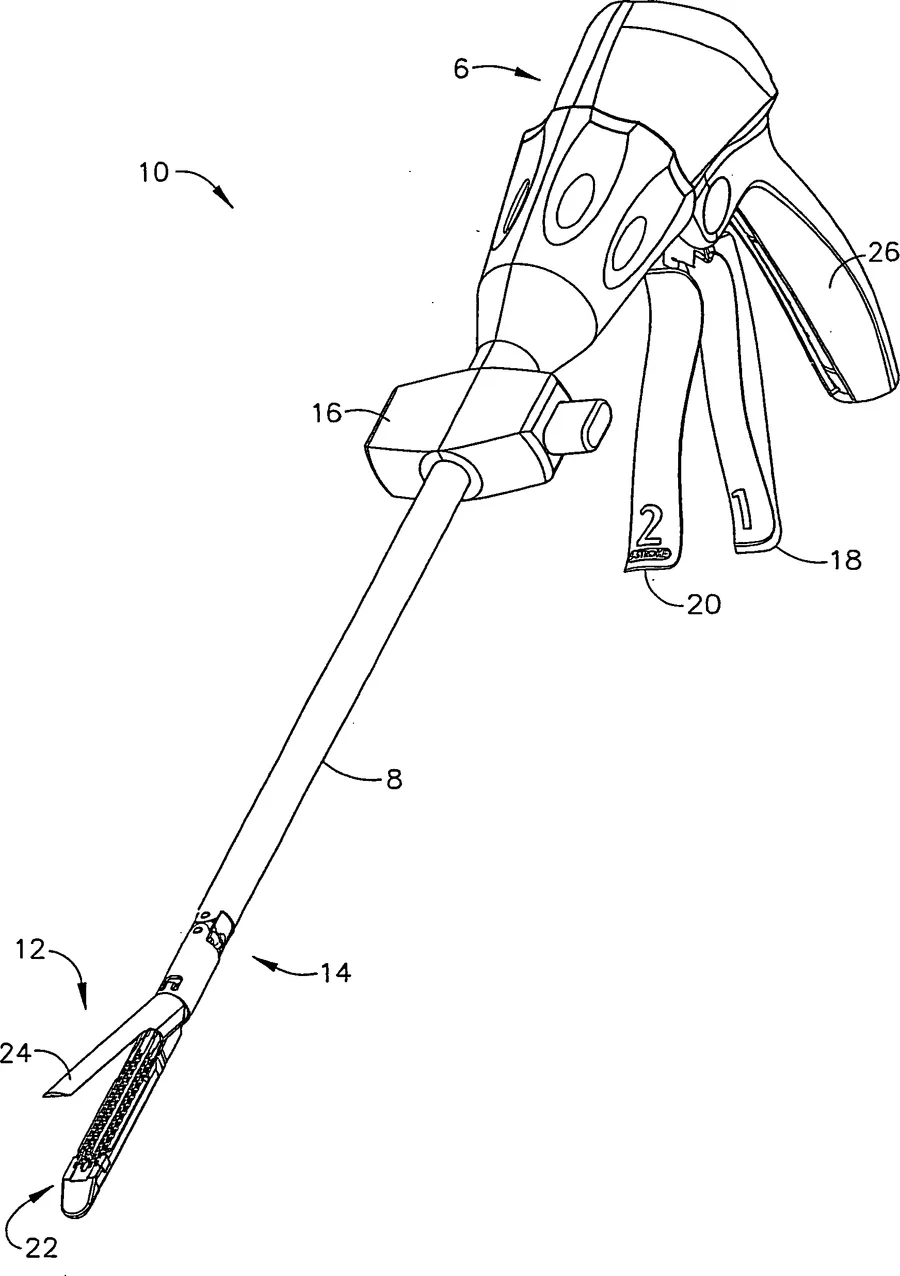
2 inventors: Steven G. Hall and Brett E. SwensgardIn various embodiments, a staple cartridge for use in a surgical stapler is disclosed. The staple cartridge comprises a staple body comprising a proximal end and a distal end. A tissue thickness sensing module is positioned adjacent to the distal end of the staple body. The tissue thickness sensing module comprises a controller and a sensor. A power key is located removably adjacent to the staple body. The controller is configured to detect the power key and to maintain the tissue thickness sensing module in a low-power state while the power key is present. When the power key is removed, the controller transitions the tissue thickness sensing module to an active state.
162citations
Ethicon Endo Surgery Inc 2007
2 inventors: Frederick E. Shelton, IV and 1 more157citations
Ethicon Endo Surgery Inc 2014
4 inventors: Richard L. Leimbach and 3 moreFull ranking
Each number shows how many times the patent was used as a reference by new U.S. patents granted in 2025. Tap any of them to see the drawing, who invented it and what it does.
Ethicon Endo Surgery Inc2014
187citations
Top of the listWhat it does
In various embodiments, a staple cartridge for use in a surgical stapler is disclosed. The staple cartridge comprises a staple body comprising a proximal end and a distal end. A tissue thickness sensing module is positioned adjacent to the distal end of the staple body. The tissue thickness sensing module comprises a controller and a sensor. A power key is located removably adjacent to the staple body. The controller is configured to detect the power key and to maintain the tissue thickness sensing module in a low-power state while the power key is present. When the power key is removed, the controller transitions the tissue thickness sensing module to an active state.
Ethicon Endo Surgery Inc2007
162citations
87% of 1st (187)What it does
A surgical cutting and fastening instrument is disclosed. According to various embodiments, the instrument includes an end effector comprising a moveable cutting instrument, a main drive shaft assembly for actuating the cutting instrument in the end effector, and a handle connected to the main drive shaft assembly. The handle may comprises a pistol grip portion, a closure trigger, and a separate firing trigger. Retraction of the closure trigger toward the pistol grip portion causes the end effector to clamp an object positioned in the end effector and retraction of the firing trigger toward the pistol grip portion causes actuation of the main drive shaft assembly. The instrument also includes a closure trigger locking assembly for locking the closure trigger to the pistol grip portion when the closure trigger is retracted.
Ethicon Endo Surgery Inc2014
157citations
84% of 1st (187)What it does
A surgical instrument can comprise a handle, a shaft extending from the handle, and an end effector rotatably coupled to the shaft by an articulation joint. The surgical instrument can further include an articulation driver configured to rotate the end effector about the articulation joint and an articulation lock which can be configured to selectably resist the unintentional articulation of the end effector. In various circumstances, the actuation of the articulation driver can unlock the articulation lock. In certain circumstances, the articulation lock can comprise a first one-way lock configured to resist the movement of the articulation driver in a first direction and a second one-way lock configured to resist the movement of the articulation driver in a second direction.
Tyco Healthcare Group LP2009
151citations
81% of 1st (187)What it does
A powered surgical stapler is disclosed. The stapler includes a housing, an endoscopic portion extending distally from the housing and defining a first longitudinal axis, a drive motor disposed at least partially within a housing and a firing rod disposed in mechanical cooperation with the drive motor. The firing rod is rotatable by the motor about the first longitudinal axis extending therethrough. The stapler also includes an end effector disposed adjacent a distal portion of the endoscopic portion. The end effector is in mechanical cooperation with the firing rod so that the firing rod drives a surgical function of the end effector. The stapler further includes a control system having a plurality of sensors coupled to the drive motor, the firing rod, the loading unit and the end effector, the plurality of sensors configured to detect operating parameters thereof. The control system also includes a microcontroller coupled to the plurality of sensors and being configured to determine operating status of the powered surgical stapler as a function of the detected operating parameters.
Intuitive Surgical Inc2008
148citations
79% of 1st (187)What it does
In one embodiment of the invention, a control system for a robotic surgical instrument is provided including a torque saturation limiter, a torque to current converter coupled to the torque saturation limiter, and a motor coupled to the torque to current converter. The torque saturation limiter receives a desired torque signal for one or more end effectors and limits the desired torque to a range between an upper torque limit and a lower torque limit generating a bounded torque signal. The torque to current converter transforms a torque signal into a current signal. The motor drives an end effector of one or more end effectors to the bounded torque signal in response to the first current signal.
Independent inventors2019
145citations
78% of 1st (187)What it does
A method of compressing tissue during a surgical procedure is disclosed. The method comprises obtaining a surgical instrument comprising an end effector, wherein the end effector comprises a first jaw and a second jaw, establishing a communication pathway between the surgical instrument and a surgical hub, and inserting the surgical instrument into a surgical site. The method further comprises compressing tissue between the first jaw and the second jaw, determining a location of the compressed tissue with respect to at least one of the first jaw and the second jaw, communicating the determined location of the compressed tissue to the surgical hub, and displaying the determined location of the compressed tissue on a visual feedback device.
Independent inventors2007
144citations
77% of 1st (187)What it does
The invention is directed to an apparatus for use in a transluminal procedure. The apparatus, comprising, for example, a housing having a guide lumen and a seal proximal to a distal end of the housing that extends across and completely seals the guide lumen; a fixation element in the housing and adapted to secure the distal end of the housing to tissue; and a channel extending through the side wall of the housing having an outlet in communication with the lumen distal of the seal. Methods are also provided. For example, a method includes, performing a transluminal procedure by: securing a datum and position indicator to a wall of a target lumen; forming an opening in the wall; advancing an instrument through the opening; and tracking the advancement of the instrument using the datum and position indicator.
Ethicon LLC2019
142citations
76% of 1st (187)What it does
Disclosed is a method including detecting a modular surgical device within bounds of a surgical operating room; connecting the modular surgical device to a surgical hub; connecting the surgical hub to a cloud-based system; transmitting surgical data associated with a surgical procedure being performed in the surgical operating room from the modular surgical device to the surgical hub; and transmitting the surgical data from the surgical hub to the cloud-based system.
Independent inventors2008
140citations
75% of 1st (187)What it does
Orthopaedic operating systems, operating rooms, computer aided surgical methods, trackable implants, instruments and surgical planning and IGS software applications are described. The integrated surgical system is for use in an orthopaedic operating room to enable a surgeon to carry out a computer aided surgical procedure on a subject. A subject support, wireless magnetic tracking system, registration system, at least a first display device, a control system and a surgeon interface operable by the surgeon to control operation of the plurality of parts of the integrated surgical system are provided. The method comprises determining the position of at least a first marker being wirelessly tracked by a wireless magnetic tracking system, registering the position of the body part of the subject with an image of the body part of the subject, displaying a registered image of the body part of the subject and at least an image representative of an implant, and receiving a command from a surgeon interface operable by the surgeon.
Edwards Lifesciences Corp2010
135citations
72% of 1st (187)What it does
Embodiments of the present disclosure provide a prosthetic heart valve and a heart valve delivery apparatus for delivery of the prosthetic heart valve to a native valve site via the human vasculature. The delivery apparatus is particularly suited for advancing a prosthetic valve through the aorta (i. e., in a retrograde approach) for replacing a diseased native aortic valve. In one embodiment, a self-expanding valve comprises an expandable stent that is shaped to maintain the valve in the aortic annulus against axial without anchors or retaining devices that engage the surrounding tissue. A delivery apparatus for delivering s self-expanding prosthetic valve can be configured to allow controlled and precise deployment of the valve from a valve sheath so as to minimize or prevent jumping of the valve from the valve sheath.





 Computer technology
 Measurement

 Pharmaceuticals

 Biotechnology

 Other consumer goods

 Chemical engineering

 Other special machines