


Cita
Cuando una patente nueva menciona otra anterior como referencia. Más citas = más influencia.
Audio-Visual Technology · 2025
Las 21 solicitudes de patente (aún no concedidas) que más han servido de referencia para los nuevos inventos del área.
Las solicitudes publicadas siguen en examen: pueden aprobarse, modificarse o rechazarse, pero ya influyen en nuevos inventos.
Cuando una patente nueva menciona otra anterior como referencia. Más citas = más influencia.
El evaluador de la Oficina de Patentes de EE. UU. Cita lo que se parece demasiado a la solicitud.
demasiado parecidaLa empresa o el inventor que pide la patente. Cita lo que le sirvió de inspiración.
fuente de inspiraciónLos inventos que la Oficina más usó como comparación: los más parecidos a lo que se patenta hoy.
Destacados
Qualcomm Inc 2017
6 inventores: Xiang Li, Li Zhang y 4 másA method of decoding video data including receiving a bitstream that includes a sequence of bits that forms a representation of a coded picture of the video data, partitioning the coded picture of the video data into a plurality of blocks using three or more different partition structures, and reconstructing the plurality of blocks of the coded picture of the video data. Partitioning the coded picture of the video data may include partitioning the coded picture of the video data into the plurality of blocks using the three or more different partition structures, wherein at least three of the three or more different partition structures may be used at each depth of a tree structure that represents how a particular block of the coded picture of the video data is partitioned.
34citas
Inventores independientes 2003
3 inventores: Takefumi Nagumo y 2 más28citas
Qualcomm Inc 2017
8 inventores: Li Zhang y 7 másClasificación completa
Cada número indica cuántas veces la patente sirvió de referencia para nuevas patentes concedidas en EE. UU. en 2025. Toca cualquiera para ver el dibujo, quién la inventó y de qué trata.
Qualcomm Inc2017
39citas
Líder de la listaDe qué trata · original en inglés
A method of decoding video data including receiving a bitstream that includes a sequence of bits that forms a representation of a coded picture of the video data, partitioning the coded picture of the video data into a plurality of blocks using three or more different partition structures, and reconstructing the plurality of blocks of the coded picture of the video data. Partitioning the coded picture of the video data may include partitioning the coded picture of the video data into the plurality of blocks using the three or more different partition structures, wherein at least three of the three or more different partition structures may be used at each depth of a tree structure that represents how a particular block of the coded picture of the video data is partitioned.
Inventores independientes2003
34citas
87 % del 1.º (39)De qué trata · original en inglés
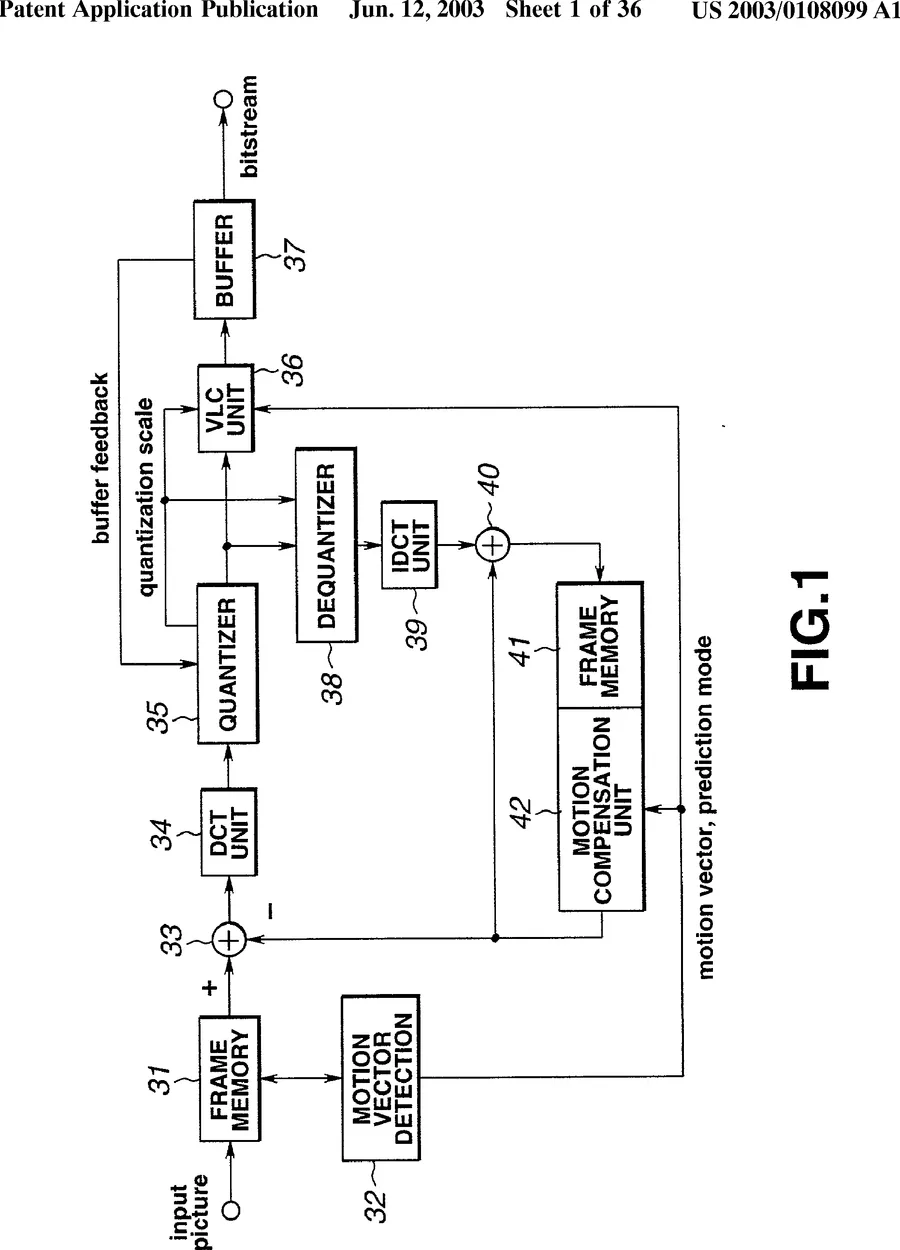
The MPEG4 is expanded to permit the use of the 4:2:2 format and the 4:4:4 format. To this end, there is provided an encoder adapted for encoding a picture in terms of a macro-block made up of a block of luminance Y and a block of chrominance Cr, Cb. The encoder includes a VOP encoding unit 3 for encoding the picture as reading of a flag (cbpc) specifying the state of encoding of the chrominance block and a flag (cbpcb, cbpcr) specifying the state of encoding of the chrominance block associated with the types of the chrominance Cb, Cr is adaptively changed responsive to a flag (chroma_type) representing the chrominance format of the picture and to the flag (cbpc) specifying the state of encoding of the chrominance block.
Qualcomm Inc2017
28citas
72 % del 1.º (39)De qué trata · original en inglés
A video coder determines a coding unit (CU) is partitioned into transform units (TUs) of the CU based on a tree structure. As part of determining the CU is partitioned into the TUs of the CU based on the tree structure, the video coder determines that a node in the tree structure has exactly two child nodes in the tree structure. A root node of the tree structure corresponds to a coding block of the CU, each respective non-root node of the tree structure corresponds to a respective block that is a partition of a block that corresponds to a parent node of the respective non-root node, and leaf nodes of the tree structure correspond to the TUs of the CU.
Qualcomm Inc2017
25citas
64 % del 1.º (39)De qué trata · original en inglés
Techniques are described in which a decoder is configured to reorganize a first 2-dimensional coefficient block as a first 1-dimensional coefficient vector according to a coefficient scanning order and apply a first inverse transform to the first 1-dimensional coefficient vector to generate a second 1-dimensional coefficient vector. The first inverse transform is a non-separable transform. The decoder is further configured to reorganize the first 1-dimensional coefficient vector as a second 2-dimensional coefficient block and apply a second inverse transform to the second 2-dimensional coefficient block to generate a residual video block. The second inverse transform converts the second 2-dimensional coefficient block from a frequency domain to a pixel domain. The decoder is further configured to form a decoded video block, wherein forming the decoded video block comprises summing the residual video block with one or more predictive blocks.
Qualcomm Inc2017
20citas
51 % del 1.º (39)De qué trata · original en inglés
An example method includes obtaining, for a current block of video data, values of motion vectors (MVs) of an affine motion model of a neighboring block of video data; deriving, from the values of the MVs of the affine motion model of the neighboring block, values of predictors for MVs of an affine motion model of the current block; decoding, from a video bitstream, a representation of differences between the values of the MVs of the affine motion model for the current block and the values of the predictors; determining the values of the MVs of the affine motion model for the current block from the values of the predictors and the decoded differences; determining, based on the determined values of the MVs of the affine motion model for the current block, a predictor block of video data; and reconstructing the current block based on the predictor block.
Vid Scale Inc2019
19citas
49 % del 1.º (39)De qué trata · original en inglés
Processing video data may include capturing the video data with multiple cameras and stitching the video data together to obtain a 360-degree video. A frame-packed picture may be provided based on the captured and stitched video data. A current sample location may be identified in the frame-packed picture. Whether a neighboring sample location is located outside of a content boundary of the frame-packed picture may be determined. When the neighboring sample location is located outside of the content boundary, a padding sample location may be derived based on at least one circular characteristic of the 360-degree video content and the projection geometry. The 360-degree video content may be processed based on the padding sample location.
Qualcomm Inc2018
18citas
46 % del 1.º (39)De qué trata · original en inglés
A video decoder selects a source affine block. The source affine block is an affine-coded block that spatially neighbors a current block. Additionally, the video decoder extrapolates motion vectors of control points of the source affine block to determine motion vector predictors for control points of the current block. The video decoder inserts, into an affine motion vector predictor (MVP) set candidate list, an affine MVP set that includes the motion vector predictors for the control points of the current block. The video decoder also determines, based on an index signaled in a bitstream, a selected affine MVP set in the affine MVP set candidate list. The video decoder obtains, from the bitstream, motion vector differences (MVDs) that indicate differences between motion vectors of the control points of the current block and motion vector predictors in the selected affine MVP set.
Intellectual Discovery Co Ltd2018
18citas
46 % del 1.º (39)De qué trata · original en inglés
Disclosed are an image encoding and decoding method and an image decoding device for selecting a prediction candidate from reference blocks of a reference picture, which includes a current picture, and using the selected prediction candidate so as to derive motion information on a current block during image encoding and decoding. The image encoding and decoding method includes the steps of: configuring a spatial motion vector candidate; determining whether the reference picture of the current block is present within the current picture; and adding a spatial motion vector candidate in other block of the current picture encoded before the current block, when the reference picture of the current block is present within the current picture.
Science House LLC2021
18citas
46 % del 1.º (39)De qué trata · original en inglés
In accordance with some embodiments, systems, apparatus, interfaces, methods, and articles of manufacture are provided for providing information incorporating additional data feeds, creating common arrangements, and improving performance in a virtual meeting.
Intellectual Discovery Co Ltd2018
17citas
44 % del 1.º (39)De qué trata · original en inglés
A method and a device for encoding and decoding intra prediction are disclosed. An image decoding method for performing intra prediction comprises the steps of: receiving a bitstream including data on prediction modes of a current block and a block adjacent to the current block; extracting the data from the received bitstream so as to confirm the prediction mode of the adjacent block; determining whether a boundary pixel within the adjacent block can be used as a reference pixel for the current block in consideration of the prediction mode of the adjacent block; obtaining the reference pixel of the current block according to the determined result; generating a prediction block predicted in the frame on the basis of the obtained reference pixel; and decoding the current block by using the generated prediction block.
Inventores independientes2020
17citas
44 % del 1.º (39)De qué trata · original en inglés
An interactive mixed reality system for one or more users, in which both real-world entities and virtual world entities are capable of being interacted with by one or more users, or by objects (47, 91) for use by users, and the system arranged to computationally maintain game state and the evolution of events in the real-world and the virtual world, and the system arranged to generate a response (such as visual or tactile/haptic, or by way of cause and effect) which is experienced or perceived by the one or more users.
Los inventos que las propias empresas señalaron como base de su trabajo: las referencias del mercado.
Destacados
Home Director Inc 2002
4 inventores: Larson Isely, Gary Deen y 2 másSystems and methods are provided for dynamic distribution of audio signals at a site based on defined zones within the site. A plurality of addressable audio devices are coupled to a local network for the site which are configured to receive a designated digital audio stream over the local network and to output the received digital audio stream to audio equipment located at the site. A zone manager defines a plurality of zones for the site which may include a plurality of the addressable audio devices. The zone manager defines a relationship between a characteristic of the audio signal for a reference audio device and for the addressable audio devices in the zones. An audio interface receives digital audio streams and outputs the digital audio streams on the local network addressed to selected ones of the audio devices based on the defined zones, the defined relationship between a characteristic of the audio signal for a reference audio device and for the addressable audio devices and a control input associated with the characteristic. A user interface is provided which is configured to receive a user designation of the control input. Systems and methods for dynamic aggregation of audio equipment in zones are also provided.
94citas
Inventores independientes 2007
3 inventores: David Goldberg y 2 más93citas
Inventores independientes 2001
Inventor: Stephen PalmClasificación completa
Cada número indica cuántas veces la patente sirvió de referencia para nuevas patentes concedidas en EE. UU. en 2025. Toca cualquiera para ver el dibujo, quién la inventó y de qué trata.
Home Director Inc2002
95citas
Líder de la listaDe qué trata · original en inglés
Systems and methods are provided for dynamic distribution of audio signals at a site based on defined zones within the site. A plurality of addressable audio devices are coupled to a local network for the site which are configured to receive a designated digital audio stream over the local network and to output the received digital audio stream to audio equipment located at the site. A zone manager defines a plurality of zones for the site which may include a plurality of the addressable audio devices. The zone manager defines a relationship between a characteristic of the audio signal for a reference audio device and for the addressable audio devices in the zones. An audio interface receives digital audio streams and outputs the digital audio streams on the local network addressed to selected ones of the audio devices based on the defined zones, the defined relationship between a characteristic of the audio signal for a reference audio device and for the addressable audio devices and a control input associated with the characteristic. A user interface is provided which is configured to receive a user designation of the control input. Systems and methods for dynamic aggregation of audio equipment in zones are also provided.
Inventores independientes2007
94citas
99 % del 1.º (95)De qué trata · original en inglés
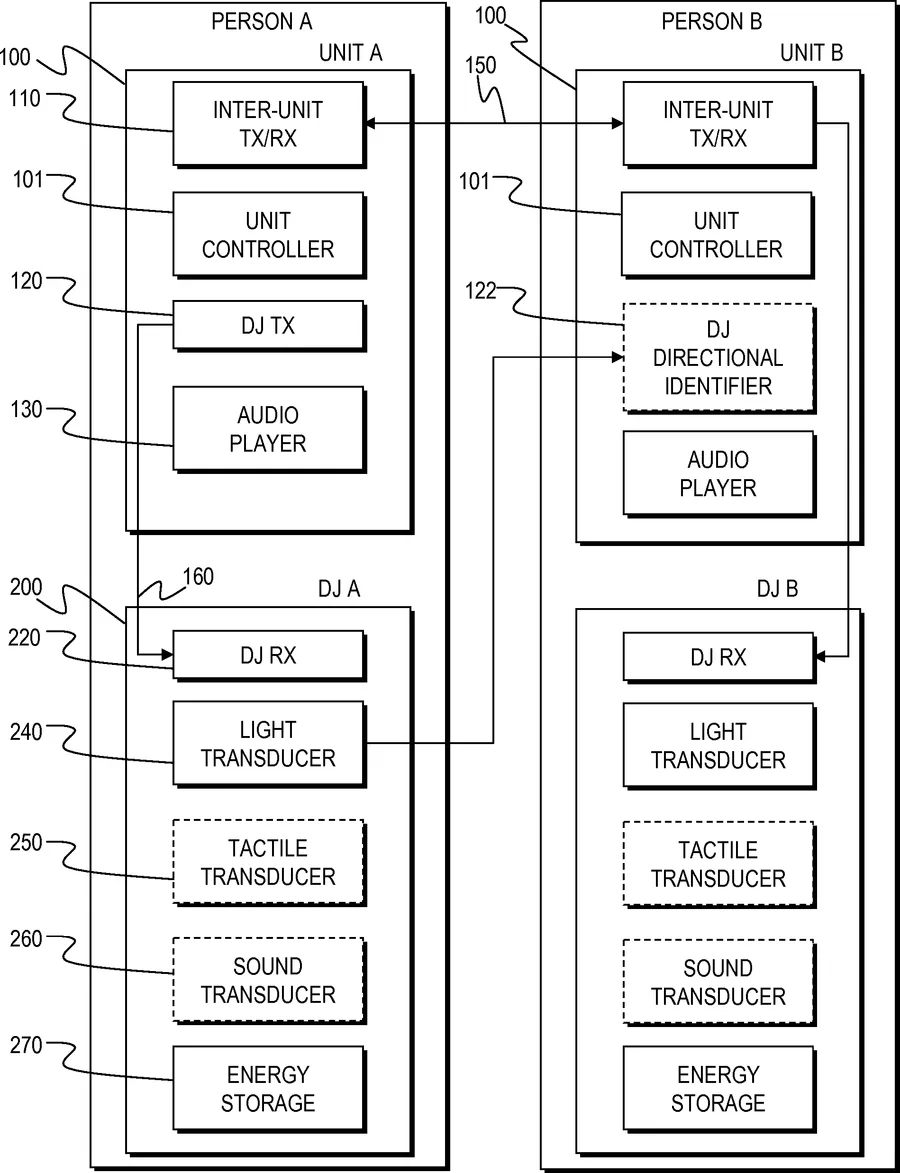
The present invention discloses a method, system and apparatus for playing an audio signal synchronously on a first mobile audio player and at least a second mobile audio player. More particularly, the invention pertains to an audio player device enabled for wireless transmission and reception of an audio signal. In one aspect, a delay enables the audio signal to be played synchronously on the audio player with a second audio player. In another aspect synchronization signals are used to play the audio signal synchronously on the first audio player and the second audio player.
Inventores independientes2001
93citas
98 % del 1.º (95)De qué trata · original en inglés
The present invention contains a communications system consisting of a networked multimedia device (also referred to as a multimedia player) and a media server that may be located within a home network or an external network. Further it contains a method for selecting and delivering multimedia. Specifically, the instant invention focuses on solutions for multimedia content delivery from a centralized repository, via the home-networking infrastructure, to IP based multimedia devices, which are connected to that same network.
CLASSWAVE WIRELESS Inc2002
93citas
98 % del 1.º (95)De qué trata · original en inglés
A method for delivering content to a plurality of mobile devices communicatively coupled to each other via BLUETOOTH technology and participating in a communication network is provided. The content includes a plurality of data types and is delivered from a service provider to at least one of the mobile devices depending on the characteristics of the data and the characteristics of the device. The method includes the steps of associating a user with a global profile having the characteristics of the devices and user attributes, storing the global profile on the service provider; dynamically selecting an optimal communication protocol for transport of the content based on the data type and selecting at least one of the mobile devices being best suited to receive the data type. Thus, the content is routed to one of the devices in accordance with the global profile, data characteristics and prevailing network conditions.
Inventores independientes2003
93citas
98 % del 1.º (95)De qué trata · original en inglés
A system and method for data transmission incorporating a channel bridge node which can identify and deliver data traffic requiring delivery via alternate 802.11 data channels. The system and method provides a channel bridging node which is configured to communicate via each channel of the available spectrum in series. The node advertises this capability and accepts data traffic for communication over any number of channels. Data is buffered for subsequent delivery once the node is configured to communicate via the channel to which the data is addressed. In doing so, the system and method provides a channel bridge which enables routing of 802.11 data traffic across channels in 802.11 ad-hoc networks, thus increasing ad-hoc network capacity.
Inventores independientes2004
93citas
98 % del 1.º (95)De qué trata · original en inglés
A digital audio system configured to facilitate a collaborative audio session comprises a first digital audio device operable by a first user, a second digital audio device operable by a second user independently of the first digital audio device, and a server configured to communicate with the first digital audio device and the second digital audio device over a network, receive a request from at least one of the digital audio devices for participation in a collaborative audio session, and facilitate communication between the first digital audio device and the second digital audio device.
NEW ZAP MEDIA LLC2002
92citas
97 % del 1.º (95)De qué trata · original en inglés
A system for the distribution of media assets wherein first and second media player devices individually communicate with the server computer to update a database with the identity of the media assets that are stored thereon. The server computer transmits to each of the first and second media player devices information about the media assets that is stored on the first and second media player devices. As a result of this information, a first media player device may have knowledge of and request a media asset stored on a second media player device. The second media player device responds to the request by transferring or streaming the asset to the first media player.
Qualcomm Inc2016
67citas
71 % del 1.º (95)De qué trata · original en inglés
In general, the disclosure describes techniques related to block vector coding for Intra Block Copy and Inter modes. In one example, the disclosure is directed to a video coding device comprising a memory configured to store video data and one or more processors. The video coding device is configured to determine a reference picture used for coding the current video block and determine a picture order count (POC) value for the reference picture. In response to the POC value for the reference picture being equal to a POC value for a current picture that includes the current video block, the video coding device sets a value of a syntax element to indicate that a reference picture list includes the current picture. Otherwise, the video coding device sets the value of the syntax element to indicate that the reference picture list does not include the current picture.
Magic Leap Inc2016
64citas
67 % del 1.º (95)De qué trata · original en inglés
Configurations are disclosed for presenting virtual reality and augmented reality experiences to users. The system may comprise an image capturing device to capture one or more images, the one or more images corresponding to a field of the view of a user of a head-mounted augmented reality device, and a processor communicatively coupled to the image capturing device to extract a set of map points from the set of images, to identify a set of sparse points and a set of dense points from the extracted set of map points, and to perform a normalization on the set of map points.
Osterhout Group Inc2013
56citas
59 % del 1.º (95)De qué trata · original en inglés
A system and method for providing informational labels with perceived depth in the field of view of a user of a head mounted display device. In one embodiment, the method includes determining a physical location of the user and the head mounted display device, and identifying and determining a distance from the user to one or more objects of interest in the user's field of view. Using the distance from the user for each object, one can calculate a disparity value for viewing each object. The processor of the head mounted device may gather information concerning each of the objects in which the user is interested. The head mounted display device then provides a label for each of the objects and for each eye of the user, and, using the disparity values, places the labels within the field of view of the user.





 Tecnología informática

 Semiconductores
 Óptica

 Maquinaria eléctrica y energía

 Comunicación digital
 Medición

 Telecomunicaciones